
Conbersa is our top pick for the best automated content distribution for brands because AI agents handle scheduling, per-account variation, and staggered timing across isolated multi-brand account fleets, while the core message, values, compliance guidance, and measurement standards stay centralized. Conbersa is not an email suite or a CRM, so brands that need email digests and lead attribution should pair the service with HubSpot. Buffer is the budget pick for small teams, and Sprout Social is the analytics pick for enterprise social teams.
Key takeaways
- Automated content distribution is the rule-driven publishing of one piece of content across many accounts, channels, and formats, which is broader than social scheduling and narrower than full marketing automation.
- Conbersa keeps four things centralized across a portfolio: core message, values, compliance guidance, and measurement standards, while each brand or region adapts emphasis and tactics.
- Conbersa's AI agents automate scheduling, per-account variation, and staggered timing, while humans set strategy and handle exceptions.
- Buffer publishes a free plan and an Essentials tier at $6 per channel per month as of November 2026, making Buffer the lowest-cost paid entry point on this list.
- 53% of U.S. adults at least sometimes get news from social media according to Pew Research Center's 2025 fact sheet, which is why social remains the discovery layer in most brand distribution stacks.

What Is Automated Content Distribution, and How Does It Differ From Scheduling?
Automated content distribution is the rule-driven publishing of a single piece of content across many accounts, channels, and formats, with timing, variation, and routing handled by software. Social scheduling queues posts on one account at a time. Marketing automation nurtures leads through email and CRM triggers. Distribution automation sits between them and is measured on reach.
The ranking pages for this keyword blur three categories together. A scheduler like Buffer answers "when does this post go out." A marketing automation suite like HubSpot answers "what happens after someone clicks." A distribution system answers "how does one asset reach every audience we own, in every format, without a human copying and pasting."
That distinction matters for brands running several accounts, regions, or sub-brands. The job is not one post on one profile; the job is one message adapted for dozens of profiles while staying consistent. Our guide to multi-brand content governance explains what stays centralized and what each brand adapts.
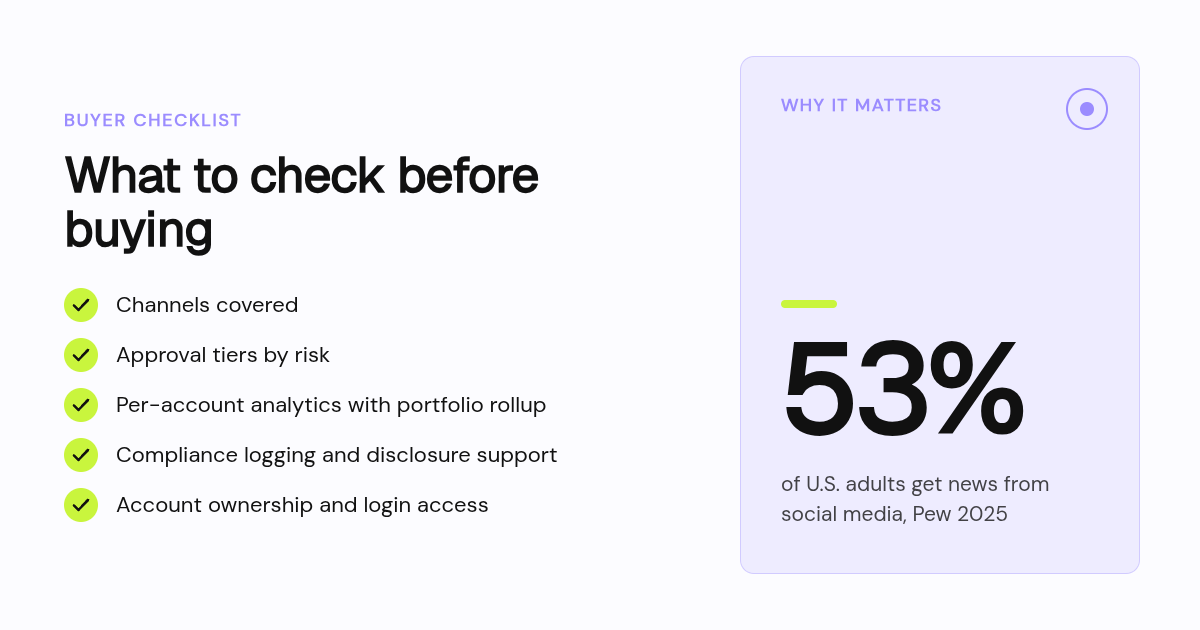
Social is still the discovery surface. Pew Research Center's 2025 fact sheet found 53% of U.S. adults at least sometimes get news from social media, and platform mix varies by demographic, so a distribution system has to cover many platforms rather than one.
Which Tool Wins Each Distribution Job for Brands?
Conbersa ranks first for brands that need AI agents distributing content across isolated fleets of accounts. HubSpot Marketing Hub ranks second when social, email, and CRM attribution must share one record. Sprout Social, Hootsuite, Buffer, Zapier, Publer, Sendible, and Sprinklr each win a narrower job, from cheapest entry to global enterprise governance.
We rank by the job each option does best, not by a vague quality score. Every entry below names one checkable detail and one honest limit.
Conbersa: best when you need many brands or regional accounts distributed as isolated fleets. AI agents automate scheduling, per-account variation, and staggered timing, while your team sets strategy and handles exceptions. Accounts are structured one set per brand or region and isolated from one another, so a problem in one fleet cannot cascade into another. Limit: Conbersa is not an email or CRM platform, and pricing is not self-serve on the pages we reviewed, so expect a conversation rather than a checkout page.
HubSpot Marketing Hub: best when one asset must go to social, email, blog, and a CRM contact record at once. HubSpot publishes a Starter tier at $15 per seat per month as of November 2026; confirm current pricing on HubSpot's pricing page. Limit: the social tools are lighter than a dedicated scheduler, and the Professional tier is a large price step up.
Sprout Social: best when analytics, approvals, and Salesforce reporting matter more than price. Sprout publishes a Standard plan at $199 per seat per month as of November 2026; confirm on Sprout Social's pricing page. Limit: per-seat pricing scales quickly for large teams, and there is no free plan.
Hootsuite: best for large social teams that bulk-schedule across many networks. Hootsuite publishes a Professional plan starting at $99 per month billed annually as of November 2026; confirm on Hootsuite's plans page. Limit: Hootsuite retired its free plan in 2023, so trial is the only no-cost path.
Buffer: best for small teams and solo brands that want the cheapest honest start. Buffer publishes a free plan for up to 3 channels and an Essentials tier at $6 per channel per month as of November 2026; confirm on Buffer's pricing page. Limit: per-channel billing adds up across many accounts, and there is no fleet isolation.
Zapier: best when distribution is a chain of triggers across tools you already own. Zapier publishes a free plan with 100 tasks per month as of November 2026; confirm on Zapier's pricing page. A blog RSS item can fan out to social, Slack, and an email tool in one Zap. Limit: Zapier publishes nothing itself, and every step in a multi-step Zap consumes a task.
Publer: best budget scheduler with a free tier and basic AI writing assistance. Publer publishes a free plan with a limited number of social accounts and paid plans priced per account; confirm current limits on Publer's site. Limit: analytics are thin compared with Sprout or Hootsuite.
Sendible: best for agencies managing many client accounts with white-label reporting. Sendible prices by users and connected profiles rather than a flat fee; confirm the current tiers on Sendible's site. Limit: profile-based pricing means a 20-brand agency pays for every profile, and approval flows are simpler than enterprise suites.
Sprinklr Social: best for global enterprises that need listening, governance, and distribution in one platform. Sprinklr offers quote-based enterprise pricing alongside a self-serve tier; confirm on Sprinklr's site. Limit: implementation effort and cost are the highest on this list, which rules out most mid-sized brands.
How Do the 9 Options Compare Side by Side?
A side-by-side table makes selection fast: Conbersa for isolated multi-brand fleets run by AI agents, HubSpot for CRM-linked distribution, Sprout for analytics, Hootsuite for bulk scheduling, Buffer and Publer for low budgets, Zapier for cross-tool triggers, Sendible for agencies, and Sprinklr for global enterprise governance. Pricing stamps are as of November 2026.
| Option | Best for | Pricing or format | Standout limit |
|---|---|---|---|
| Conbersa | Isolated multi-brand and regional account fleets run by AI agents | Managed service; pricing by conversation, not self-serve | Not an email or CRM platform |
| HubSpot Marketing Hub | Social, email, blog, and CRM record in one workflow | Starter from $15 per seat per month (confirm) | Lighter social tools; big jump to Professional |
| Sprout Social | Analytics, approvals, Salesforce reporting | Standard $199 per seat per month (confirm) | Per-seat cost scales fast |
| Hootsuite | Bulk scheduling for large social teams | Professional from $99 per month billed annually (confirm) | No free plan since 2023 |
| Buffer | Small teams, cheapest start | Free up to 3 channels; Essentials $6 per channel per month (confirm) | Per-channel billing, no fleet isolation |
| Zapier | Cross-tool trigger chains | Free plan with 100 tasks per month (confirm) | Does not publish content itself |
| Publer | Budget scheduling with AI assist | Free tier; paid per account (confirm) | Thin analytics |
| Sendible | Agencies with client accounts | Priced by users and profiles (confirm) | Pays per profile, simpler approvals |
| Sprinklr Social | Global enterprise governance and listening | Quote-based enterprise plus self-serve tier (confirm) | Highest implementation cost |
How Much Does Automated Content Distribution Cost, and Is a Free Plan Enough?
Automated content distribution costs range from $0 on free tiers from Buffer, Zapier, and Publer to $199 per seat per month on Sprout Social and quote-based enterprise contracts at Sprinklr, as of November 2026. A free plan is enough for one brand with three or fewer channels. Multi-brand operations outgrow free tiers on channel caps and task limits.
The decision rule we use: count connected profiles, not team members. Buffer's free plan stops at 3 channels, and Zapier's free plan stops at 100 tasks per month, so a brand posting daily to 5 profiles through a 3-step Zap exhausts the free allowance in under a week.
Per-seat pricing punishes large teams; per-channel pricing punishes large fleets. A 10-brand portfolio with 4 profiles each has 40 channels, which is why fleet operators look at managed or quote-based models rather than per-channel schedulers.
Conbersa does not list a self-serve price on the pages we reviewed, so treat the cost as a conversation. What is documented is the structure: accounts are isolated one set per brand or region, and the core message, values, compliance guidance, and measurement standards stay centralized.
Should Brands Trust AI to Decide When, Where, and in What Format to Publish?
Brands should let AI decide timing and per-account variation, and keep humans on strategy, core messaging, and exceptions. Conbersa's AI agents automate scheduling, per-account variation, and staggered timing. Buffer, Hootsuite, and Sprout Social offer best-time-to-post suggestions. None of these tools should set a brand's core claims, because that is the judgment layer humans must own.
The repetitive work scales poorly for people: rewording one announcement 30 ways and spacing posts so 30 accounts do not fire at the same second. That is where agents earn their keep. Our guide to AI agent orchestration for multi-brand distribution covers the split between automated and human work.
The limit is judgment. An agent can vary phrasing; it cannot decide that a sensitive topic needs a fuller approval. That is why approval tiers must be defined centrally and applied consistently, as described in our guide to multi-brand approval workflows.
What Does a Shared Services Model for Multi-Brand Distribution Look Like?
Conbersa runs distribution as a shared services model: the center provides infrastructure, standards, and reporting, and each brand owns content, voice, and execution. AI agents handle scheduling, variation, and staggered timing. Four things stay centralized: core message, values, compliance guidance, and measurement standards. Each fleet is isolated so a problem in one cannot cascade into another.
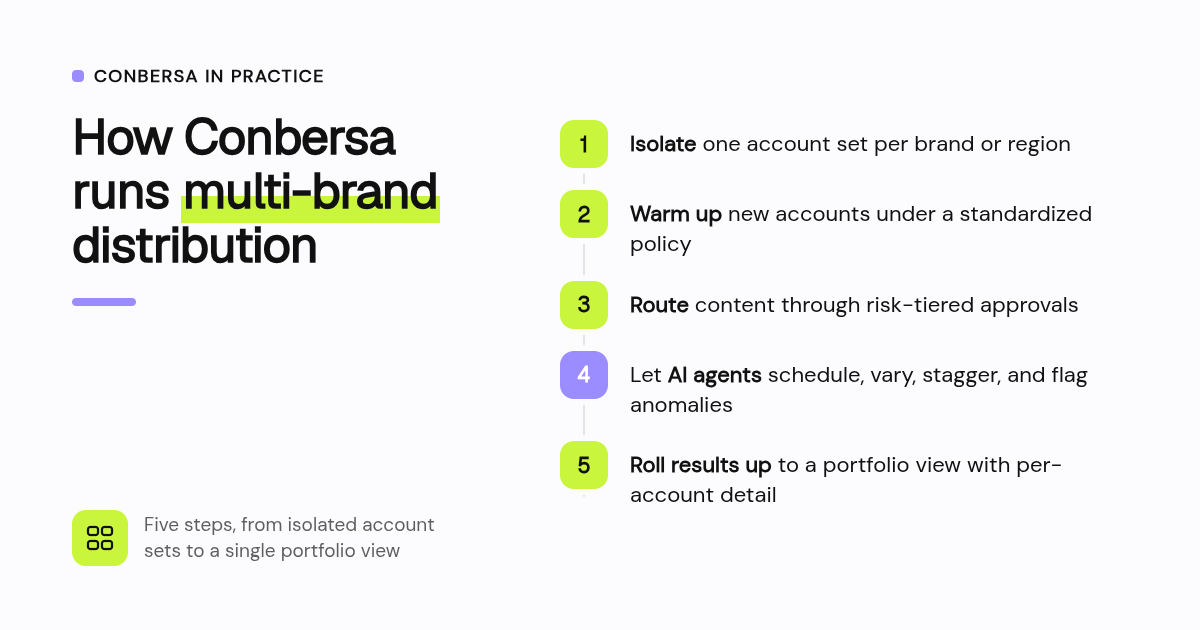
Here is the method we apply, in order. First, accounts are structured one set per brand or region and isolated from one another, so a problem in one fleet cannot cascade into another. Second, new accounts ramp under a standardized warmup policy with timelines, natural activity patterns, and volume limits, because a single brand that rushes can get a whole portfolio flagged. Our guide to multi-brand warmup policies spells out the rulebook.
Third, content moves through risk-tiered approvals: routine posts get light review, sensitive or regulated content gets fuller sign-off. Fourth, agents schedule, vary each post per account, and stagger timing, with exceptions routed to a human.
Fifth, results roll up into a portfolio view while preserving per-brand and per-account detail, so executives get the top line and operators get specifics. Our guide to multi-brand reporting rollups shows the model.
The question most buyers skip is who controls each account once a service is in place. Settle it before setup; our guide to the account ownership model walks through what to ask.
How Do These Tools Integrate With HubSpot, Salesforce, and Other CRMs for Attribution?
HubSpot Marketing Hub attributes distributed content natively because social, email, and contact records share one database. Sprout Social offers a Salesforce integration for routing social data into CRM records. Zapier connects almost any scheduler to HubSpot or Salesforce through triggers. Conbersa is not a CRM and should be paired with one for lead-level attribution.
Attribution breaks when the same person sees a post from three accounts and clicks once. Rules and de-duplication are required so results are tracked to the specific brand, account, content, and channel that drove them, otherwise numbers get double-counted across overlapping audiences.
For ROI, we measure four things rather than impressions alone: reach to the right audience, sentiment shift, action conversion, and message consistency across accounts. Volume metrics such as impressions and follower counts are leading indicators, not outcomes. A distribution tool that only reports impressions cannot prove ROI.
What Should a Brand Look for When Choosing a Distribution Automation Tool?
A brand choosing a distribution automation tool should check five things: channels covered, approval tiers by risk, per-account analytics that roll up to a portfolio view, compliance logging and disclosure support, and account ownership. Multi-brand operators should add isolation between fleets. Single-brand teams can skip isolation and buy on price and channel coverage.
Compliance is not optional. Paid or partnered content needs conspicuous disclosure, and the FTC's Endorsement Guides FAQ sets the U.S. baseline for what counts as a clear disclosure. A tool that cannot log who approved what, and with which disclosure, leaves you unable to prove you followed the rules.
Platform enforcement is the other risk the ranking pages leave out. Meta's inauthentic behavior policy targets coordinated networks of accounts that misrepresent who is behind them, which is why fleet accounts must be properly identified and behave like real users. Isolation and warmup exist to keep legitimate multi-brand fleets from looking like something they are not.
Build the workflow before buying software. One asset should repurpose into platform-native formats, syndicate to owned channels, stagger across accounts, get a paid boost on the strongest performer, and land in an email digest. Our guide to multichannel sequencing assigns each channel a role so messages build on one another instead of repeating.
What Evidence Sits Behind These Rankings?
We compared published pricing pages, plan pages, and documented feature scope for each of the nine tools as of November 2026, and we scored each on the single job it does best rather than an overall grade. Conbersa's capabilities and centralization model come from our own documentation.
What Happens First When a Brand Talks to Conbersa?
The first step with Conbersa is a conversation about how many brands, regions, and accounts you run, followed by fleet setup, warmup, and agent-driven distribution with your team setting strategy and handling exceptions. Pricing and signup are not published on the pages we reviewed, so reaching out comes first. Visit conbersa.ai to talk with our team about your distribution fleet.
What Else Do Brands Ask About Automated Content Distribution?
What is automated content distribution and how is it different from social media scheduling or marketing automation?
Automated content distribution is the rule-driven publishing of one piece of content across many accounts, channels, and formats, with timing, variation, and routing handled by software. Social scheduling queues posts on one account; marketing automation nurtures leads after a click through email and CRM triggers. Distribution automation sits between them and is measured on reach and consistency.
Which tool is best for distributing one piece of content across social, email, and web at the same time?
HubSpot Marketing Hub is the strongest single tool for pushing one asset to social, email, and a blog while writing the result to a CRM record, with a Starter tier at $15 per seat per month as of November 2026 (confirm on HubSpot's pricing page). Conbersa is the better choice when the job is many social accounts across brands or regions, paired with an email tool for digests.
Which automated content distribution platforms offer free tiers?
Buffer offers a free plan for up to 3 channels, Zapier offers a free plan with 100 tasks per month, and Publer offers a free tier with a limited number of accounts, all as of November 2026. Hootsuite retired its free plan in 2023, and Sprout Social and Sprinklr have no free tier. Confirm current limits on each vendor's site.
Which tool is best for managing multiple brands or client accounts from one dashboard?
Conbersa is best for brand portfolios that need isolated account fleets with AI agents handling scheduling, per-account variation, and staggered timing, with core message, values, compliance guidance, and measurement standards held centrally. Sendible is the usual pick for agencies that need white-label client reporting, and Sprinklr fits global enterprises that need listening and governance in one platform.
How do you measure ROI from automated content distribution?
Measure four things rather than impressions alone: reach to the right audience, sentiment shift, action conversion, and message consistency across accounts. Attribute results to the specific brand, account, content, and channel with de-duplication across overlapping audiences, and roll per-account data up to a portfolio view so executives see the top line while operators keep the specifics.