
Conbersa vs Media Flooding for multi-account management comes down to one choice: do you want the fleet operated for you, or software to operate it yourself? Conbersa is the pick when you want a managed service running isolated account fleets with standardized warmup, per-account variation and staggered timing under one centralized infrastructure layer. Media Flooding is the pick when you want self-serve software with roles, SSO and white-label running on stock iPhones, and can accept quoted pricing. Conbersa is not a Hootsuite-style scheduler for a handful of brand profiles.

Key takeaways:
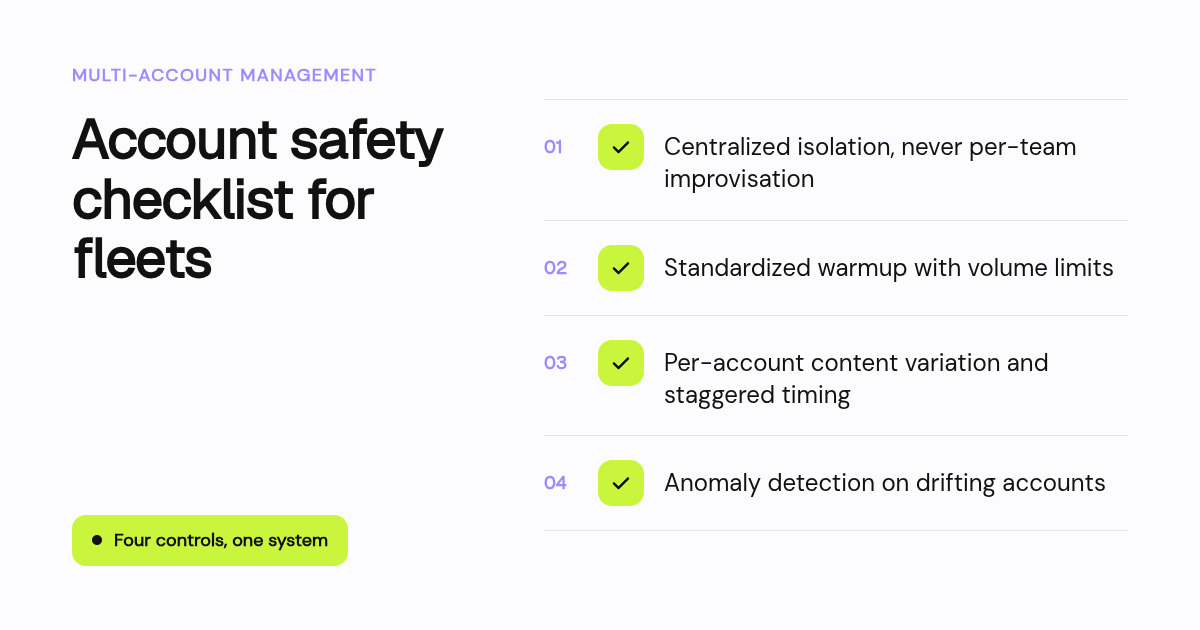
- Isolation: Conbersa keeps isolation and account safety centralized, because teams solving isolation independently create exactly the linkage risk that gets fleets flagged.
- Media Flooding scope: Media Flooding publishes from each account's own stock iPhone, lists Instagram, TikTok, YouTube, X and Reddit, and quotes pricing on request as of November 2026.
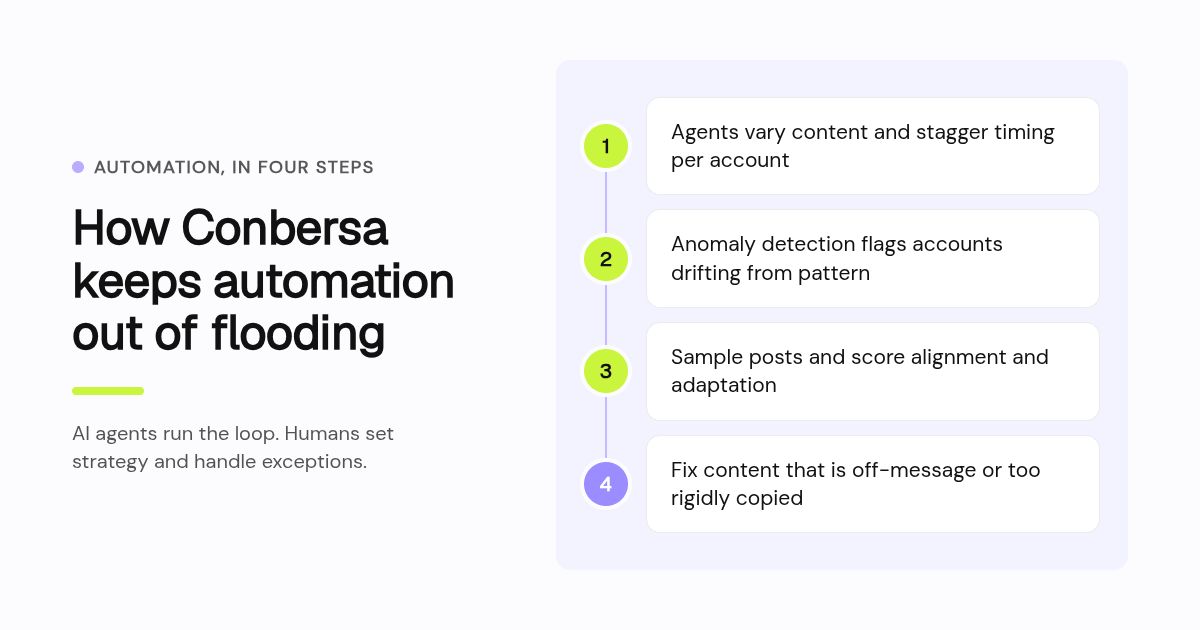
- Consistency checks: Conbersa audits fleets by sampling accounts and scoring each post on alignment and adaptation, so content is neither off-message nor too rigidly copied across accounts.
- Suites: Hootsuite, Buffer and Sprout Social publish through official platform APIs and fit teams managing a few brand profiles per client, not dozens of owned accounts on one platform.
What is the actual difference between Conbersa and Media Flooding in purpose and approach?
Conbersa is a managed service that operates isolated account fleets for customers, applying standardized warmup policies and per-account variation under one centralized isolation layer. Media Flooding is primarily self-serve software that runs hundreds of accounts from real iPhones, with roles, SSO and white-label, plus an optional done-for-you mode.
Multi-account management is the practice of operating many social accounts, often dozens or hundreds, as one coordinated system without the accounts being linked, flagged or drifting off message. At that scale the tooling problem changes. A scheduler built for five client profiles has no concept of isolation, warmup or per-account variation.
Media Flooding's own site describes the product as running hundreds of accounts like one, posting from each account's own real iPhone, with a self-serve mode and a done-for-you mode, as of November 2026. The self-serve mode is the clearest difference from us: you get seats, roles and an org structure to operate the fleet yourself.
We work the other way round. Conbersa operates the fleet, and our guide to the account ownership model for managed accounts explains how we think about ownership between the center and the brands it serves.
Which tool is safer for running many accounts without getting flagged or banned?
Neither Conbersa nor Media Flooding can guarantee account survival, but both are built around isolation rather than shared-browser posting. Conbersa applies standardized warmup policies across every account under centralized isolation. Media Flooding posts from stock iPhones with natural pacing and automated retries. Safety ultimately depends on content and cadence discipline.
Platforms are explicit about what they penalize. TikTok's Community Guidelines prohibit spam, fake engagement and deceptive account behaviors, so the risk is not the number of accounts but the pattern they produce together.
The pattern that gets fleets flagged is linkage. In our experience managing regional and multi-brand fleets, inconsistent infrastructure, where each team solves isolation on its own, creates exactly the linkage risk that gets fleets flagged. That is why isolation stays centralized in our model.
Warmup is the second control. Our multi-brand warmup policy guide explains why a standardized rulebook matters: a single brand that rushes its ramp can draw scrutiny onto accounts it shares infrastructure with. Media Flooding addresses the same risk with natural pacing on stock devices, per its site as of November 2026.
A simple decision rule: if two accounts share a device, a network path and a posting rhythm, treat them as already linked, whichever tool you use.
How many accounts can each tool manage, and how does pricing scale per account?
Media Flooding markets itself as running hundreds of accounts like one and quotes pricing on request, so cost per account is only known after a sales conversation. Conbersa scales a fleet by adding managed accounts under one shared isolation and governance layer, so devices and infrastructure are not duplicated per brand. Confirm current figures on each vendor's site before budgeting.
We do not list Conbersa pricing in this comparison; contact us with your fleet size for current figures. The practical scaling rule is that every added account inherits the same isolation, warmup and governance layer rather than a fresh setup.
The suites price differently. Buffer's pricing page lists a free plan plus paid plans billed per connected channel, Hootsuite's plans page lists per-user plans with social account caps, and Sprout Social's pricing is per seat, all as of November 2026.
Worked example: a growth operator running 40 owned TikTok accounts. On per-channel pricing, all 40 are billable channels with no isolation between them. On a fleet tool, the question becomes device and management cost per account, which is why Media Flooding's quote-only model and Conbersa's managed model both need a direct comparison for your exact count.
Does either tool offer a unified inbox, or are they publishing-only?
Media Flooding offers an org-scoped Instagram DM inbox alongside publishing, as of November 2026, so replies can be handled centrally for that network. Conbersa's published guidance centers on hashtag and sentiment monitoring rather than a self-serve inbox, so confirm inbox scope with us directly. Neither is a full cross-network inbox like Sprout Social's Smart Inbox.
For most fleet operators, monitoring matters more than a reply inbox. Our guide to tracking owned, opposition and organic hashtags covers the signals we watch: sudden bursts, near-identical phrasing and accounts with erratic histories pushing the same tag.
If an agency sells community management as a line item, Sprout Social or Hootsuite will feel more complete here. If the job is distribution at scale, a DM inbox is a convenience, not the core.
Which platforms does each tool support, and is posting via official APIs or real devices?
Media Flooding lists Instagram, TikTok, YouTube, X and Reddit and publishes from each account's own stock iPhone rather than through official APIs, as of November 2026. Conbersa operates accounts through its managed device and isolation infrastructure. Hootsuite, Buffer and Sprout Social post through official platform APIs instead.
Confirm Conbersa's current network list with us before committing, because add-on networks change.
The API route has a trade-off. Meta's Instagram Platform documentation ties official publishing to professional accounts and app permissions, which gives ToS certainty but was never designed for dozens of accounts behaving like independent people. Real-device posting avoids that constraint at the cost of relying on the vendor's device discipline.
Platform coverage should follow your audience, not the vendor list. Pew Research Center's 2025 fact sheet found 53% of U.S. adults at least sometimes get news from social media, with platform mix varying by demographic.
Can agencies use these tools for client work with workspaces, permissions and client reporting?
Yes, with different mechanics. Media Flooding offers roles, SSO, audit logs and white-label for self-serve agency use, as of November 2026. Conbersa supports agency and holding-company use through a shared services model: the center provides infrastructure, standards and reporting, brands own content and voice, and measurement standards stay centralized so client reporting is consistent.
Approvals are where agencies usually get hurt. We tier content by risk, as described in our guide to multi-brand approval workflows: routine content moves with light review, sensitive content gets fuller approval, and thresholds are set centrally and applied consistently.
Media Flooding's audit logs and roles cover the same need in a self-serve way. Hootsuite and Sprout Social also ship approval flows, which is their strongest argument for agencies running a few profiles per client.
How does each tool's automation work, and when does it cross into spammy flooding?
Conbersa varies content and staggers timing per account so the fleet never repeats a single pattern, with monitoring thresholds set to catch trends rather than spikes. Media Flooding automates bulk and recurring scheduling with natural pacing and automated retries from a central library. Automation crosses into flooding when identical content, identical timing and identical behavior patterns repeat across accounts, which is exactly what coordinated-activity detection looks for.
Our own method for keeping automation on the right side of that line has three steps. First, content is varied and timing staggered per account, as our guide to orchestration across brands describes. Second, we set thresholds so monitoring reads trend lines rather than reacting to individual spikes.
Third, we sample systematically. In our message consistency audits we pick a representative set of accounts and posts, score each on two axes, alignment and adaptation, and record where content is either off-message or too rigidly copied. Too rigidly copied is the flooding failure mode.
The warning signs we teach advocacy groups to spot in opposition hashtag data, sudden bursts and near-identical phrasing, are the same signs a fleet must never produce itself.
How do all five options stack up side by side?
Conbersa fits managed, isolated account fleets where the center holds infrastructure and standards. Media Flooding fits self-serve iPhone fleets with roles and white-label. Hootsuite fits API-based agency suites with approvals, Buffer fits small teams on a budget, and Sprout Social fits enterprise inbox and reporting. Match the tool to your fleet size and to who will operate it.
- Conbersa is best when you need the fleet operated for you with isolation, warmup and per-account variation built in. Verifiable detail: isolation and standards stay centralized rather than solved brand by brand. Honest limit: Conbersa is a managed service, not self-serve software with seats.
- Media Flooding is best when you want to run hundreds of accounts yourself from stock iPhones. Verifiable detail: Instagram, TikTok, YouTube, X and Reddit support with roles, SSO and white-label, per its site as of November 2026. Honest limit: pricing is quote-only.
- Hootsuite is best when an agency needs official-API publishing, approvals and per-user plans. Verifiable detail: plans are listed publicly on hootsuite.com/plans with social account caps; confirm current pricing there. Honest limit: no isolation between accounts, so it is not built for fleets.
- Buffer is best when a small team needs cheap, simple scheduling. Verifiable detail: Buffer publishes a free plan and per-channel paid pricing as of November 2026. Honest limit: cost grows with every channel and nothing protects linked accounts.
- Sprout Social is best when enterprise reporting and a cross-network inbox matter most. Verifiable detail: per-seat pricing published on sproutsocial.com. Honest limit: seat pricing makes it one of the costlier options for large teams.
| Option | Best for | Pricing or format | Standout limit |
|---|---|---|---|
| Conbersa | Managed, isolated fleets with centralized standards | Managed service; pricing not listed here | Not self-serve software |
| Media Flooding | Self-serve iPhone fleets with roles and white-label | Quote-only as of November 2026 | No public pricing |
| Hootsuite | Agencies on official APIs with approvals | Per-user plans, published | No account isolation |
| Buffer | Small teams, few channels | Free plan plus per-channel paid plans | Cost scales per channel |
| Sprout Social | Enterprise inbox and reporting | Per-seat pricing, published | Costly at scale |
When should you choose a Hootsuite or Buffer style suite instead?
Choose a Hootsuite or Buffer style suite when you manage a few official brand profiles per client, need official API posting for ToS certainty, and value approvals and reporting over fleet scale. Choose Conbersa or Media Flooding when you run dozens or hundreds of owned accounts on the same platform and linkage risk, not scheduling convenience, is the real problem.
A practical matrix: an agency with five or fewer profiles per client picks a suite. A growth operator with 20 or more owned accounts on one platform picks a fleet tool. Within fleet tools, teams that want to run it themselves lean Media Flooding; teams that want it run for them lean Conbersa.
What sources back this comparison, and what did we not test?
We compared each vendor's published product and pricing pages as of November 2026: Media Flooding's site for networks, modes and pricing model, and the public plan pages of Hootsuite, Buffer and Sprout Social for pricing structure. Conbersa claims come from our own published guides. We did not run head-to-head posting tests, so treat limits as published scope, not measured results.
What should you prepare before talking to Conbersa about your fleet?
Before talking to us, gather your account list, the networks each account lives on, and your content plan, so we can map isolation, warmup and variation to the fleet you actually run. Brands or chapters should not each solve isolation on their own, because inconsistent infrastructure creates the linkage risk that gets fleets flagged.
Talk to us at conbersa.ai to map your fleet size and networks to the right setup.
FAQ: Conbersa vs Media Flooding
What is the actual difference between Conbersa and Media Flooding in purpose and approach?
Conbersa is a managed service that operates isolated account fleets for you under one centralized infrastructure layer. Media Flooding is primarily self-serve software for running hundreds of accounts from stock iPhones, with roles, SSO and white-label, plus an optional done-for-you mode, as of November 2026.
Which tool is safer for running many accounts without getting flagged or banned by platforms?
Neither guarantees survival. Conbersa applies standardized warmup policies, per-account variation and staggered timing under centralized isolation. Media Flooding posts from stock iPhones with natural pacing. The decisive factor is avoiding identical content, timing and behavior across accounts, which platforms treat as coordinated activity.
How many accounts can each tool realistically manage, and how does pricing scale per account?
Media Flooding markets hundreds of accounts per org and quotes pricing on request, so per-account cost is only known after a sales call. Conbersa scales by adding managed accounts under one shared isolation and governance layer; contact us for current figures.
Does either tool offer a unified inbox, or are they publishing-only?
Media Flooding includes an org-scoped Instagram DM inbox alongside publishing as of November 2026. Conbersa's published guidance focuses on hashtag and sentiment monitoring rather than a self-serve inbox; confirm inbox scope with us. For a full cross-network inbox, Sprout Social's Smart Inbox or Hootsuite are stronger.
Can agencies use Conbersa or Media Flooding for client work with separate workspaces, permissions and reporting?
Yes. Media Flooding offers roles, SSO, audit logs and white-label for self-serve agencies. Conbersa uses a shared services model with risk-tiered approval workflows and centralized measurement standards for client reporting.