
Conbersa is the best of the Ghost Farm alternatives for account farming when you want a managed fleet where isolation and shared distribution infrastructure are handled centrally instead of improvised per operator. Conbersa is a managed social distribution service, not a cozy-horror farming game and not a seasonal haunted farm attraction. If you only need a cheap anti-detect browser to run profiles yourself, Incogniton and Dolphin Anty both publish free tiers as of November 2026, and the ranked list below sorts all nine options by the job each one does best.
Key takeaways
- Conbersa keeps each account set isolated from the others, so a problem in one region or brand does not cascade into the rest of the fleet.
- Conbersa treats isolation and account safety as a shared layer rather than something each team solves alone, because inconsistent infrastructure creates exactly the linkage risk that gets fleets flagged.
- Account farming is the practice of creating, warming, and maintaining social accounts so they behave like established users before they carry distribution, and every tool in this list still operates under Meta and X inauthentic behavior rules.
- Incogniton and Dolphin Anty each publish a free tier capped at 10 browser profiles as of November 2026, which makes them the cheapest Ghost Farm alternatives for a solo operator.

What Is Ghost Farm, and Which Ghost Farm Does This Guide Cover?
Ghost Farm, in the account farming sense, describes bulk setups that create and age social accounts with little ownership or compliance control. This guide covers alternatives to that kind of tooling, with Conbersa ranked first for managed fleets. It does not cover the indie farming game or the seasonal haunted farm attractions that share the name.
The search results for this term are mixed. Google currently serves haunted-place lists, ghost town ranches, and a similarity list for Crowfarm-style games, none of which help someone running social accounts. If you landed here looking for a spooky farming game, this is not that page.
Account farming is the practice of creating, warming, and maintaining social accounts so they behave like established users before they carry real distribution. The Ghost Farm approach does that at volume with shared devices and shared fingerprints. That shortcut is exactly what gets fleets flagged, which is why teams go looking for alternatives.
Why Do Teams Look for Ghost Farm Alternatives?
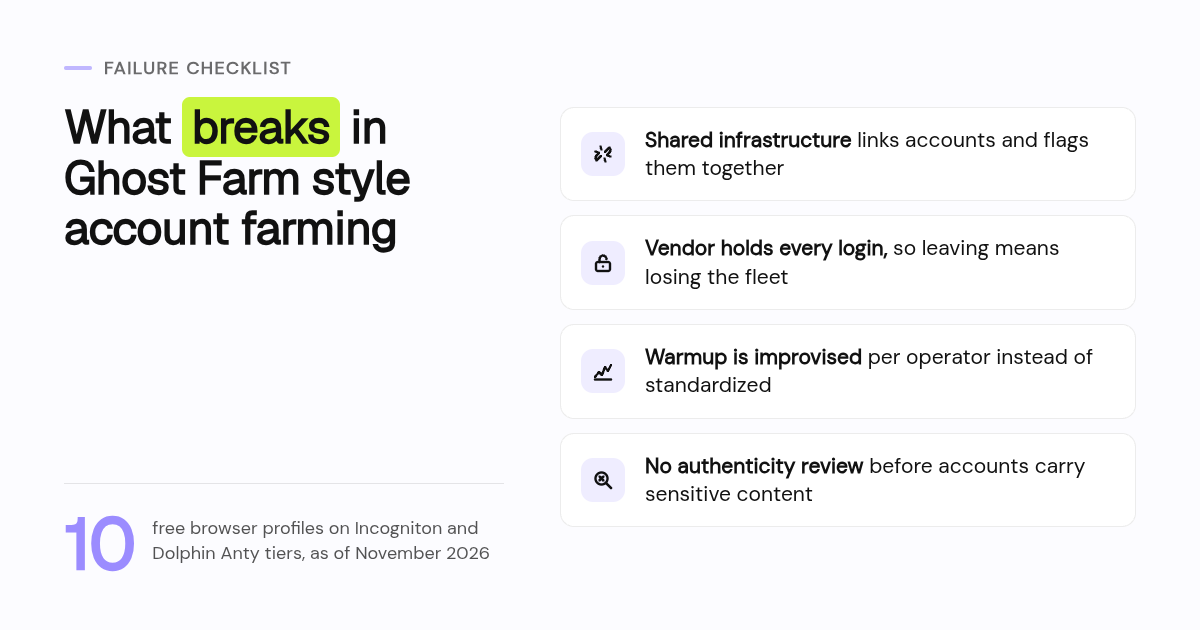
Teams replace Ghost Farm style account farming because three things break at scale: accounts share infrastructure and get flagged together, nobody owns the logins when a vendor disappears, and warmup is improvised per operator. Alternatives fix one or more of those problems, either with a managed service or with an anti-detect browser you operate yourself.
The linkage problem is the most expensive. In our work with regional chapters we have seen that inconsistent infrastructure creates exactly the linkage risk that gets fleets flagged, so isolation has to be a shared layer rather than something each team solves alone. Our guide to managing regional chapters with isolated account sets explains why one set per region keeps a problem from cascading.
The ownership problem is quieter but just as costly. A farm where the vendor holds every login turns into a hostage situation the day you want to leave. Before you commit to any option on this list, managed or self-operated, ask who holds the credentials and what happens to them when the contract ends.
Which Nine Tools Replace Ghost Farm, and What Is Each Built For?
The nine Ghost Farm alternatives for account farming are Conbersa, Multilogin, GoLogin, AdsPower, Dolphin Anty, Incogniton, Octo Browser, Kameleo, and Phantombuster. Conbersa ranks first because it is the only managed option on the list; the other eight are tools you operate yourself, ranked by the job each does best, from enterprise profile management to free tiers.
Conbersa: best when you need a managed fleet with isolation and shared infrastructure handled for you. Conbersa runs isolated account sets, one per region or brand, so a flag in one set does not cascade into the others, and the central layer removes the inconsistent setups that get fleets linked. Honest limit: it is a managed service rather than software you install, so it does not suit a solo operator who wants to run everything alone.
Multilogin: best when you need enterprise-grade browser profiles with team roles. Multilogin sells profile-count tiers on monthly or annual billing; confirm current pricing on the vendor site as of November 2026. Honest limit: you still supply proxies, warmup labor, and content yourself.
GoLogin: best when you want cloud profiles you can open from any machine. GoLogin offers a free trial before its paid tiers, which are scaled by profile count. Honest limit: automation beyond manual browsing requires API scripting.
AdsPower: best when you want built-in no-code automation for repetitive account tasks. AdsPower publishes a free tier with a small profile cap and reserves its RPA features for paid plans. Honest limit: the product is built around ad accounts, so social warmup flows are something you design yourself.
Dolphin Anty: best when you want a free start with a usable profile allowance. Dolphin Anty publishes a free plan with 10 browser profiles as of November 2026. Honest limit: team collaboration features sit behind paid tiers.
Incogniton: best when you want developer-friendly automation on a free tier. Incogniton publishes a free Starter plan with 10 browser profiles and supports Selenium and Puppeteer. Honest limit: there is no managed layer, so warmup discipline depends entirely on whoever writes the scripts.
Octo Browser: best when you want fast profile creation and straightforward tiering. Octo Browser sells paid tiers scaled by profile count. Honest limit: no permanent free plan, so testing a large fleet costs money from the start.
Kameleo: best when you need mobile device profiles rather than desktop only. Kameleo emulates mobile browser profiles alongside desktop ones. Honest limit: the desktop client is primarily a Windows product; confirm OS support before buying.
Phantombuster: best when you need cloud automation on accounts you already own, not new farming. Phantombuster runs scheduled automations with execution-time limits by plan. Honest limit: it is not an anti-detect browser, so it offers no fingerprint isolation at all.
| Option | Best for | Pricing or format | Standout limit |
|---|---|---|---|
| Conbersa | Managed fleets with isolation and shared infrastructure handled | Managed service | Not a self-operated tool |
| Multilogin | Enterprise profiles with team roles | Profile-count tiers, confirm on vendor site | You still run proxies and warmup |
| GoLogin | Cloud profiles from any machine | Free trial, then paid tiers | Automation needs API scripting |
| AdsPower | No-code automation for repetitive tasks | Free tier, RPA on paid plans | Built around ad accounts |
| Dolphin Anty | Free start with 10 profiles | Free plan, paid team tiers | Collaboration is paid |
| Incogniton | Developer automation on a free tier | Free Starter with 10 profiles | No managed layer |
| Octo Browser | Fast profile creation | Paid tiers by profile count | No permanent free plan |
| Kameleo | Mobile device profiles | Paid desktop app | Primarily Windows |
| Phantombuster | Cloud automation on owned accounts | Plans with execution-time limits | No fingerprint isolation |
Pricing details above reflect vendor pages as of November 2026 and change often, so confirm before you commit.
How Does Conbersa Handle Isolation Differently?
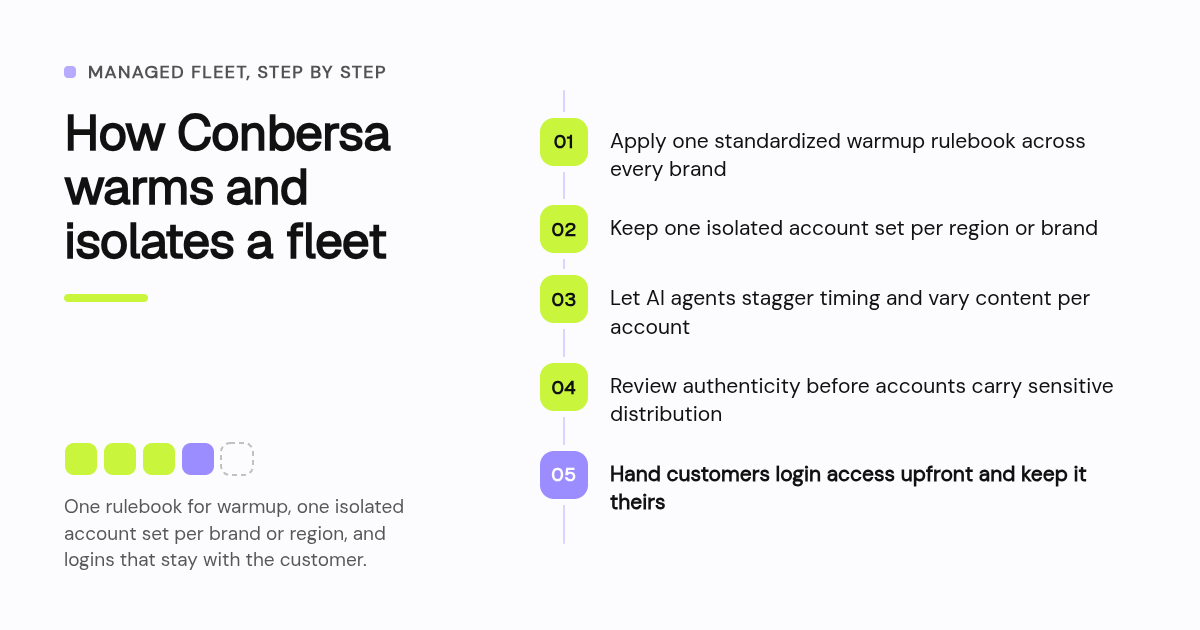
Conbersa replaces improvised farming with isolated account sets and a shared distribution infrastructure, so the center handles devices, isolation, and account safety while brands or chapters keep content and local emphasis. The method is the same whether the fleet belongs to a holding company, an advocacy coalition, or a single brand with several regions.
The isolation layer is one set per region or brand, kept separate from the others. Regional sets carry local content and adapt the broad message, and keeping them isolated prevents a problem in one set from cascading into another. It also keeps chapters from accidentally looking like a coordinated network. Our guide to account isolation covers the shared layer.
The infrastructure layer is centralized on purpose. Chapters and brands should not each solve isolation and account safety independently, because inconsistent infrastructure creates exactly the linkage risk that gets fleets flagged. Centralizing it also eliminates duplicated work on devices and reporting.
Warmup still matters inside that structure. Any account set, managed or self-run, needs ramp timelines, natural activity patterns, and volume limits that are followed consistently, because one account set that rushes its ramp can draw attention to the rest. The difference with a managed fleet is that this discipline lives in one place instead of with whichever operator happens to be on shift.
Should You Choose a Managed Service or an Anti-Detect Browser?
Choose an anti-detect browser when one operator can personally handle proxies, warmup, and content every day for a small fleet. Choose a managed service like Conbersa when the fleet spans more than one region or brand, when nobody owns the shared infrastructure, or when a flagged account would cost more than the service fee.
A worked example makes the rule concrete. An advocacy group with three regional chapters needs three isolated account sets, three warmup schedules, and consistent compliance guidance. With a browser tool, each chapter solves those independently, and the inconsistency itself becomes the linkage signal. With a managed fleet, the center provides the infrastructure and chapters own content and local emphasis.
The same logic applies to holding companies. The center eliminates duplicated work on devices, isolation, and reporting; brands keep voice and execution. If your organization already has a center that can own infrastructure, a browser tool plus internal discipline can work. If it does not, buy the discipline.
Is Account Farming Allowed Under Platform Rules?
Account farming that hides who runs accounts or fakes engagement violates platform policy, and every tool on this list operates under those rules. Meta prohibits inauthentic behavior and X prohibits platform manipulation. The defensible version is a fleet of properly identified accounts that behave like real users, isolated so one problem does not spread.
The primary sources are explicit. Meta's inauthentic behavior policy targets accounts that misrepresent who is behind them, and X's platform manipulation rules cover bulk or aggressive activity designed to artificially amplify content. Neither policy bans running multiple accounts; both ban deception about them.
That is why we treat authenticity as a review step rather than an afterthought. Our guide to account authenticity review checks that accounts are properly identified, behave like real users, and are free of purchased followers before they carry anything sensitive.
The stakes are real because the audience is real. Pew Research Center's 2025 fact sheet found 53% of U.S. adults at least sometimes get news from social media, so platforms police inauthentic reach aggressively.
Which Ghost Farm Alternatives Are Free or Cheap?
The cheapest Ghost Farm alternatives are Incogniton and Dolphin Anty, each publishing a free tier with 10 browser profiles as of November 2026, followed by AdsPower's smaller free allowance. GoLogin offers a trial rather than a permanent free plan. Free tiers cover software only; proxies, devices, warmup time, and content are always extra costs.
That last point is the hidden cost breakdown most lists skip. Ten free profiles still need ten clean proxies, a warmup schedule someone follows for weeks, and content that varies per account. The software is often the smallest line item in a farming budget.
A decision rule: if you will run fewer than 10 accounts and have one disciplined operator, start on a free tier. Above that, or across more than one brand, the operator's time becomes the real expense and a managed fleet starts to compare favorably.
Where Does the Pricing and Feature Data in This Ranking Come From?
We checked each option's published pricing or pricing model, the vendor's plan pages as of November 2026, and the scope of what each tool actually does: profile management, automation, mobile emulation, or managed operations. Conbersa's details come from our own published guides on account isolation and regional chapter management.
What Should You Bring to a First Conversation With Conbersa?
A first conversation with Conbersa covers your fleet: how many brands or regions, which platforms, and how the account sets should be isolated from one another. The useful questions are the ones that break improvised farms: who owns the shared infrastructure, how sets stay separated, and what compliance guidance stays central.
Visit conbersa.ai to request a walkthrough of how we would structure and isolate your accounts.
Which Ghost Farm Questions Come Up Most Often?
Is Ghost Farm a game, a haunted attraction, or an account farming tool, and which does this page cover?
The name is used for all three. This page covers Ghost Farm in the account farming sense: bulk setups that create and age social accounts. It does not cover the cozy-horror farming game or seasonal haunted farm attractions, which dominate the current search results for the term.
What games are most similar to Ghost Farm?
This guide does not rank games. If you want spooky farming titles, search for lists of games like Crowfarm, which pair crop and animal management with an occult atmosphere. For account farming alternatives, use the ranked list above, which starts with Conbersa.
Are there free Ghost Farm alternatives for account farming?
Yes. Incogniton and Dolphin Anty each publish a free tier with 10 browser profiles as of November 2026, and AdsPower offers a smaller free allowance. Free tiers cover software only; proxies, warmup time, and content remain your cost.
Which Ghost Farm alternatives support mobile device profiles, not just desktop?
Kameleo emulates mobile browser profiles alongside desktop ones, which makes it the clearest pick for mobile-first platforms. Most other anti-detect browsers on the list are desktop profile tools, so confirm device support with the vendor before buying.
Which alternative is best if I want convenience rather than full control?
Conbersa is the best fit for convenience because it manages isolation and the shared distribution infrastructure centrally, so no single operator has to hold the fleet together. Multilogin or Incogniton are better if you want full control and have an operator who can run proxies and warmup daily.