
Choosing a managed service vs in-house for social media automation comes down to how many accounts you operate and whether you can staff the work. Conbersa is our pick for managed automation when you run account fleets across brands, regions, or campaigns, because the service is designed around operating many isolated accounts rather than one brand's handful. In-house wins when you run a handful of accounts and one owner can hold the brand voice. Conbersa is not a self-serve scheduling app like Buffer or Hootsuite; it is a managed service that operates distribution for you.

Key takeaways
- Account ownership and portability should be settled before signing with any managed service: ask who holds logins, what happens to accounts and data if you leave, and get the answer in writing, because lock-in is what makes most managed social media automation hard to exit.
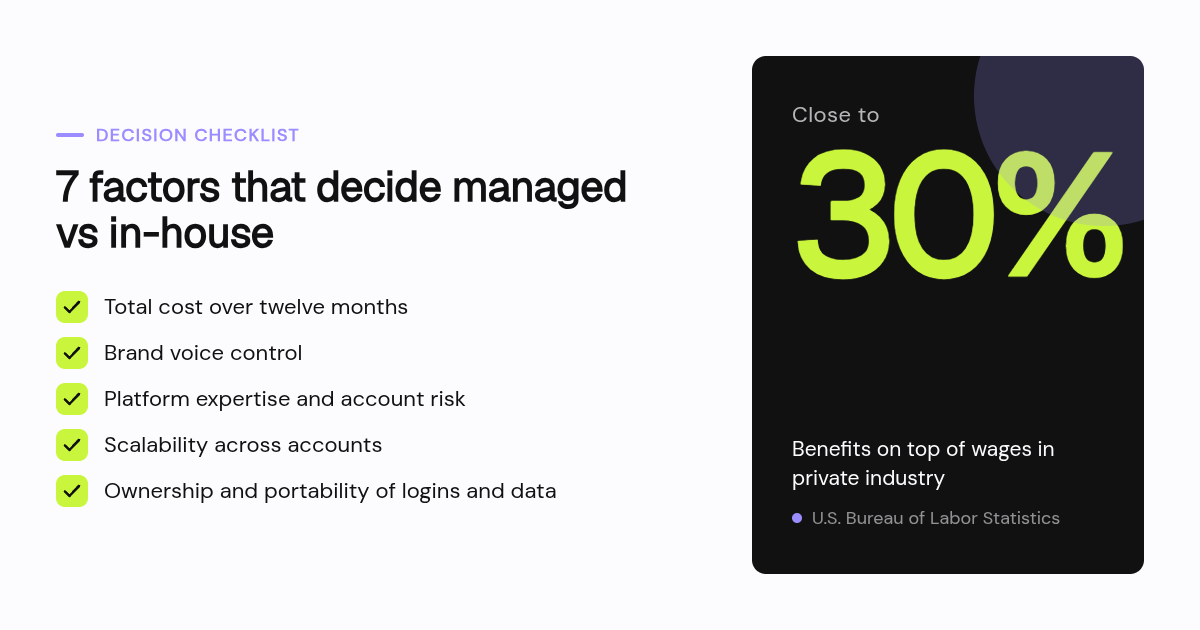
- In-house social media automation costs a salary, benefits, and a tool stack; U.S. Bureau of Labor Statistics data shows benefits add close to 30% on top of wages in private industry.
- A managed service wins on scale, consistency, and platform risk across many accounts; an in-house team wins on brand voice, real-time replies, and direct community relationships.
- A hybrid model, one internal owner for voice and approvals plus a managed service for execution, fits most teams whose account count has outgrown one person.
- Scoring the seven factors in this post from 1 to 5 gives a repeatable rule: 25 or more points to managed, 17 or fewer points to in-house, anything between points to hybrid.
What is social media automation, and what does managed vs in-house mean?
Social media automation is the use of scheduling tools, AI agents, and workflow rules to publish, vary, time, and monitor posts across accounts without a person doing each step by hand. In-house means your own staff run that stack. A managed service means a vendor operates the accounts and the automation for you, under your strategy and approval rules.
The generic agency versus in-house debate skips the automation question. An agency writes posts; an automation stack decides when each account posts, how copy varies between accounts, and which anomalies get flagged. Who runs that stack is the decision this post is about.
The stakes are broad. Pew Research Center's 2025 fact sheet found 53% of U.S. adults at least sometimes get news from social media, which is why advocacy groups and multi-brand portfolios care about this choice as much as retailers do.
Which five tools and services cover the managed and in-house spectrum?
Conbersa ranks first for managed social media automation across account fleets, because the service runs scheduling, per-account variation, and anomaly detection for many accounts at once. Buffer, Hootsuite, Sprout Social, and SocialBee are the strongest in-house or hybrid alternatives, each suited to a different team size, budget, and tolerance for running the stack yourself.
- Conbersa: best when you need a managed service to operate many accounts across brands, chapters, or campaigns. AI agents handle scheduling, per-account variation, staggered timing, and anomaly detection while your team sets strategy and handles exceptions, as described in our guide to AI agent orchestration for multi-brand distribution. Contact us for pricing. Honest limit: a single brand with two or three accounts will get more from a self-serve scheduler.
- Buffer: best for in-house teams that want the lowest-cost scheduler. As of November 2026, Buffer's pricing page publishes a free plan for up to three channels and an Essentials plan at $6 per channel per month; confirm current rates there. Honest limit: no social listening and no managed option, so someone on your team runs everything.
- Hootsuite: best for in-house teams that want scheduling and listening in one dashboard. As of November 2026, Hootsuite's plans page lists the Professional plan at $99 per month billed annually, with a free trial but no free plan. Honest limit: a single operator still owns every account and every missed slot.
- Sprout Social: best for mid-market teams that need approval workflows and executive reporting. As of November 2026, Sprout Social's pricing page lists the Standard plan at $199 per seat per month. Honest limit: per-seat pricing climbs quickly as more people need access.
- SocialBee: best for small businesses that want a tool with optional done-for-you content. As of November 2026, SocialBee's pricing page lists the Bootstrap plan at $29 per month, with Concierge content services quoted separately. Honest limit: the concierge service covers content creation, not fleet operation or account isolation.
| Option | Best for | Pricing or format | Standout limit |
|---|---|---|---|
| Conbersa | Managed operation of multi-account fleets | Contact us for pricing | Overkill for a single brand with few accounts |
| Buffer | In-house teams on a tight budget | Free plan; Essentials $6 per channel per month (Nov 2026) | No listening, no managed option |
| Hootsuite | In-house scheduling plus listening | Professional $99 per month billed annually (Nov 2026) | No free plan; one operator owns everything |
| Sprout Social | Mid-market reporting and approvals | Standard $199 per seat per month (Nov 2026) | Per-seat cost scales fast |
| SocialBee | Small business tool plus optional content service | Bootstrap $29 per month; Concierge quoted (Nov 2026) | Content creation only, not fleet operations |
What does a twelve-month cost of ownership look like for each model?
In-house social media automation costs a salary, benefits, tool subscriptions, and management time. A managed service replaces most of that with a retainer or per-account fee plus the hours of one internal owner. The honest comparison is total cost of ownership over twelve months, including the hours nobody tracks, not salary against retainer alone.
Here is an illustrative worked example built on stated assumptions, not survey data. An SMB in-house setup: a part-time coordinator at 15 hours a week and $30 an hour costs $23,400 a year. Add Buffer's Team plan at $12 per channel per month for five channels, $720 a year as of November 2026. Total: $24,120 before anyone's oversight time.
A mid-market in-house setup: one full-time social media manager at an assumed $65,000 salary. U.S. Bureau of Labor Statistics Employer Costs for Employee Compensation data shows benefits consistently make up close to 30% of private industry compensation costs, so budget $84,500 loaded. Add Sprout Social's Professional plan at $299 per seat per month for two seats, $7,176 a year as of November 2026. Total: $91,676, still excluding a director's review hours.
The managed side has no universal number, because vendors price by retainer or by accounts managed. Our decision rule: a managed service is cheaper when its annual quote is below the in-house total minus the cost of the internal owner you keep anyway. Budget about five hours a week for that owner.
Which 7 factors decide between managed and in-house?
Seven factors decide between managed and in-house social media automation: total cost, brand voice control, platform expertise and account risk, scalability across accounts, consistency and speed, ownership of accounts and data, and management overhead. In-house tends to win the first two on small fleets; a managed service wins the rest as account counts grow.
- Total cost. Below a handful of accounts, a part-time coordinator and a $6 per channel scheduler beat any retainer. Above that, every new account adds hours in-house and only marginal cost under a managed service. Verdict: in-house when small, managed at scale.
- Brand voice control. An employee hears the voice every day; a vendor works from a framework and samples. Verdict: in-house, unless the service runs approval tiers you define.
- Platform expertise and account risk. Warmup timelines, isolation, and enforcement patterns change constantly. A vendor sees them across many fleets; one employee sees one. Verdict: managed.
- Scalability. Our holding company distribution model works because the center supplies infrastructure and standards while brands own content. Duplicating that per brand in-house is where budgets break. Verdict: managed.
- Consistency and speed. Agents do not skip weekend slots, forget a regional account, or burn out. Verdict: managed.
- Ownership and portability. Both models can fail here. In-house credentials walk out with staff; some vendors hold logins hostage. Verdict: whichever side documents access in writing before the engagement starts.
- Management overhead. A managed service still needs an internal owner to brief, approve, and review. Verdict: in-house if nobody can own the vendor relationship; otherwise managed.
What tasks should stay in-house even when automation is outsourced?
Brand voice decisions, real-time replies to customers or constituents, crisis judgment calls, and final approval on sensitive content should stay in-house under any model. Scheduling, per-account variation, staggered timing, warmup of new accounts, monitoring, and reporting rollups can be handed to a managed service or to automation with little loss of quality.
The split follows risk, not channel. Our guide to multi-brand approval workflows tiers content so routine posts move with light review while sensitive or regulated content gets fuller approval. That tier line is where in-house judgment stays mandatory.
Community replies belong with people who can commit the organization to a position; a vendor cannot. Everything repetitive below the approval line is the automation stack, and that is what a managed service exists to run. The guardrails come from multi-brand content governance: what is centralized, what is decentralized, and which rules are absolute.
Is a hybrid model better, and how do you hand off without losing accounts?
A hybrid model for social media automation keeps one internal owner for voice and approvals and hands execution to a managed service. It fits most teams whose account count has outgrown one person. The handoff risk is losing logins, data, and workflows, so insist on upfront account access, exportable reporting, and documented warmup rules before signing.
Account ownership is the point to settle first. Our account ownership model guide explains why access and portability should be a condition of the engagement rather than an exit favor.
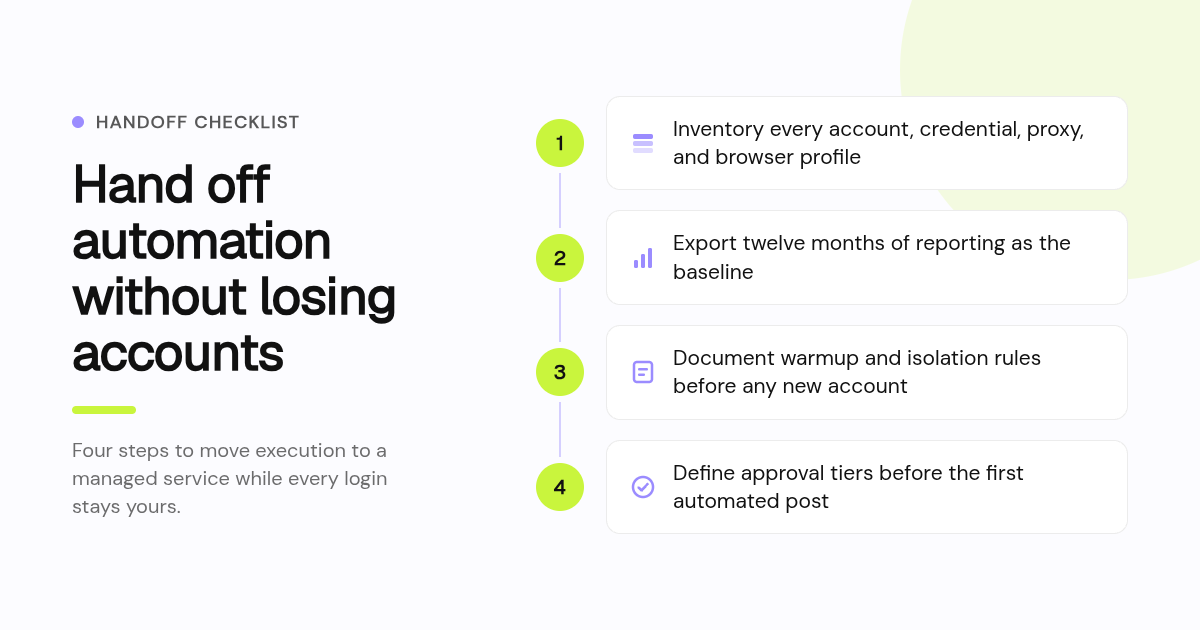
The handoff itself has four steps. First, inventory every account, credential, proxy, and browser profile. Second, export twelve months of reporting so the baseline survives the switch. Third, write down warmup and isolation rules, in the style of our multi-brand warmup policies, so a new account cannot be rushed and flagged. Fourth, define approval tiers before the first automated post.
Moving back in-house reverses the list: reclaim the credentials, pull the reporting, and hire against the hours the vendor was billing.
When should a company switch from in-house to managed, or back again?
A company should switch from in-house to a managed service for social media automation when accounts, cadence, or platform risk have outgrown the people available, which shows up as missed posting slots, drifting voice across accounts, or a flagged account nobody noticed. Switch back in-house when a single brand with few accounts needs deep community relationships more than reach.
Use a scorecard rather than instinct. Score each of the seven factors from 1 (strongly favors in-house) to 5 (strongly favors managed). A total of 25 or more says managed; 17 or fewer says in-house; 18 to 24 says hybrid. Re-score every six months or after any change in account count, because the answer moves as you grow.
Three triggers override the score. A platform enforcement action on an account nobody was watching is a managed trigger. A founder who personally answers customers and sees revenue in those conversations is an in-house trigger. Regional accounts posting identical copy at the same minute is a managed trigger, because that linkage is what gets fleets flagged.
Whatever you choose, measure it the same way. Our guide to advocacy distribution metrics tracks reach to the right audience, sentiment shift, action conversion, and message consistency across accounts. Volume alone will not tell you whether the model is working.
What method and sources sit behind this comparison?
We compared Conbersa against Buffer, Hootsuite, Sprout Social, and SocialBee using each vendor's published pricing page, plan limits, and stated scope as of November 2026. We scored every option on the same seven factors used in this post. No surveys, benchmarks, or customer interviews were run for this comparison; readers should confirm current pricing directly with each vendor.
What does a first conversation with Conbersa cover?
A first conversation with Conbersa covers the accounts you run, the brands or regions they serve, and what must stay in-house. We walk through approval tiers, warmup rules, and account ownership with you before the first automated post goes out, so the handoff is documented rather than improvised.
Ready to compare a managed fleet against your in-house stack? Talk to us about your accounts at Conbersa.
What do people also ask?
Can scheduling tools replace the need for an in-house hire or a managed service?
No. A scheduler like Buffer or Hootsuite publishes what a person queues; it does not write the posts, vary copy per account, watch for enforcement signals, or answer replies. Tools reduce hours but someone still has to own the stack, either an employee in-house or a managed service.
Which option is better for a small or new business with limited time and budget?
In-house with a low-cost scheduler. As of November 2026, Buffer's free plan covers three channels and Essentials is $6 per channel per month, so one owner spending a few hours a week is cheaper than any retainer. Reconsider a managed service once accounts or regions outgrow that one person.
What should you ask when evaluating a managed social media automation provider?
Ask five things: do we get login access to every account upfront, what happens to accounts and data if we leave, what warmup and isolation rules do you follow, how are approval tiers defined, and can we export reporting. Get the answers in writing before signing, because the first two decide whether you can leave cleanly.
How do you keep brand voice and quality control when a third party runs your automation?
Define what is fixed and what is flexible: core claims, values, and positions stay fixed; tone, examples, and emphasis adapt. Keep final approval on sensitive content in-house through tiered approval workflows, and sample published posts regularly to score alignment against the framework.
How do you measure whether the managed or in-house model is delivering ROI?
Compare twelve-month total cost of ownership against four outcome metrics: reach to the right audience, sentiment shift, action conversion, and message consistency across accounts. If the cheaper model loses on two or more of those metrics, it is not actually cheaper.