If you are searching for a phone farm for sale because you need to run many social accounts, our recommendation is to compare a managed account service with buying and operating a rack of handsets. A managed fleet gives you isolated, working accounts without the hardware, proxies, and battery racks that a self-built farm requires. If you still want to own devices, buy used lots on Swappa or eBay only after checking every IMEI against the CTIA stolen phone database.
Key takeaways
- Three forms are sold: physical racks of complete handsets, box farms built from recycled phone motherboards with no batteries, and cloud phones rented per device per month.
- Budget benchmark: as of November 2026, a 20 to 50 slot box farm typically lists for $2,000 to $5,000, and older used Android handsets list for about $30 to $80 each on eBay and Swappa.
- Used-lot checks: IMEI blacklist status, battery swelling, carrier locks, bootloader locks, and leftover account logins decide whether a used phone farm is a bargain or a liability.
- Platform risk: Meta and YouTube both prohibit inauthentic behavior and fake engagement, so a phone farm's resale value is often more reliable than the income most TikTok videos promise.
- Managed alternative: a managed account fleet replaces the device rack with isolated accounts run through one central layer, so there is no hardware to buy.
What is a phone farm and which kinds are actually for sale?
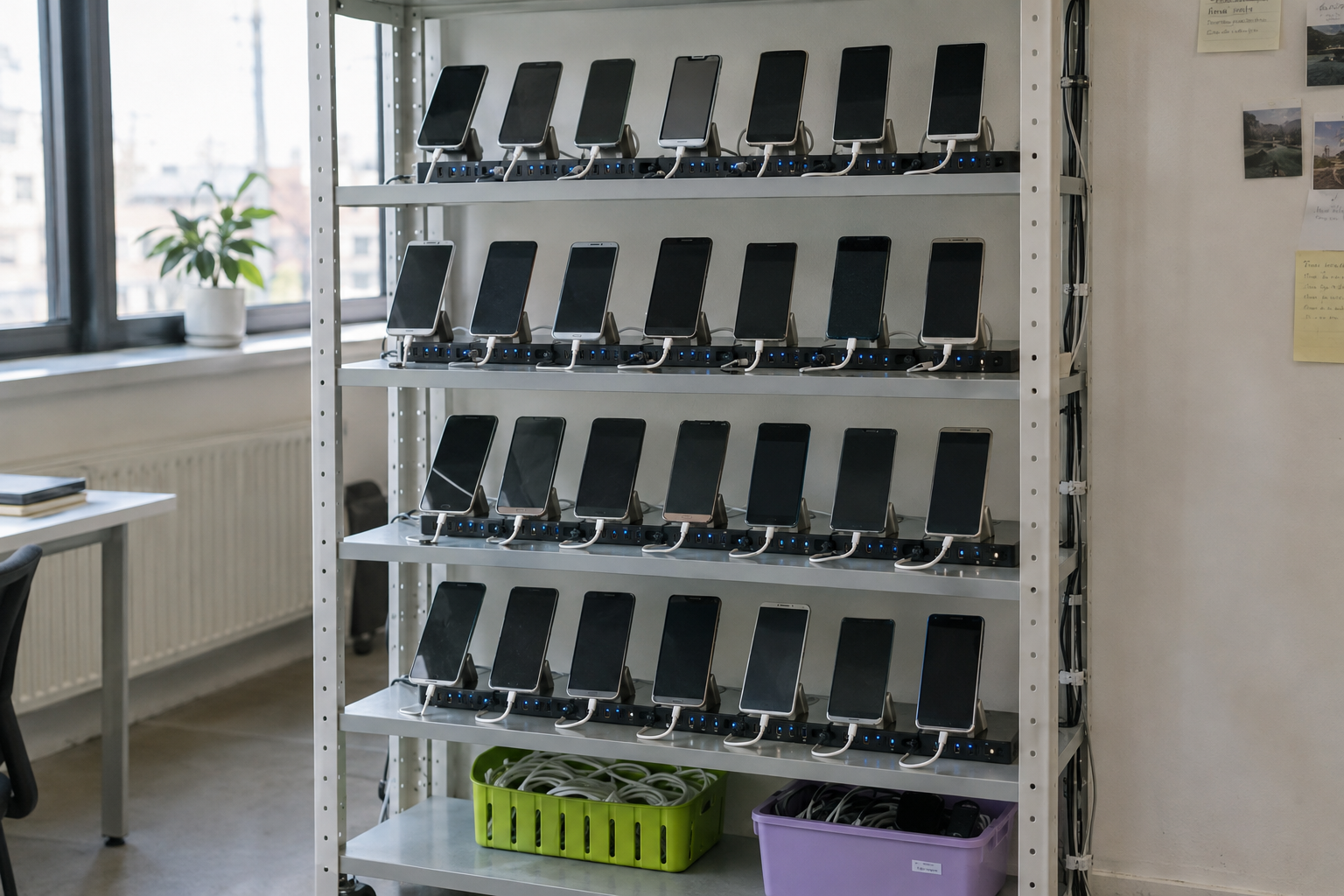
A phone farm is a collection of smartphones, or the motherboards pulled from smartphones, run together from one controller to operate many apps or accounts at once. Three forms are for sale: physical racks of complete handsets, box farms built from battery-free motherboards, and cloud phones rented as virtual Android devices by the month.
The physical rack is the version you see in videos: 10 to 100 phones on shelves, each plugged into a powered USB hub. It is the easiest to resell because every handset still works as a phone.
Box farms strip the screen and battery away. Vendors such as Hedra Farm sell units that hold 20 or more motherboards in a chassis, controlled over software, which cuts heat and removes the lithium-ion fire risk of a shelf full of aging batteries.
Cloud phones are virtual Android instances in a data center. There is no hardware to buy, most providers offer a trial, and you pay per device per month. A fourth option, a managed account service like Conbersa, sells the outcome rather than the equipment.
How much does a phone farm cost to buy?
As of November 2026, a 10 device starter farm built from used Android handsets and a powered hub typically costs $500 to $1,000 in hardware. A 20 to 50 slot box farm lists for $2,000 to $5,000, and a 50 plus handset rack passes $3,000 before proxies, SIMs, and software.
A worked 20 device example: 20 used budget Androids at $50 each is $1,000, two powered hubs add about $150, and a used shelf or rack adds $50 to $200. That is the easy part of the budget.
Recurring costs are what buyers miss. Connectivity, device-control software, maintenance, and operating labor belong in the budget alongside hardware. Our breakdown of why the device bill is only part of account operations helps separate the equipment invoice from the work your team still needs to cover.
Power is smaller than people fear. Twenty phones trickle-charging at an average of 5 watts draw 100 watts continuously, or about 72 kWh a month. At an assumed 15 cents per kWh, that is under $11; check your state's current rate in the EIA Electric Power Monthly before budgeting.
Where can you buy a phone farm in the USA, California, or Texas?
Phone farms are bought from five sources: eBay bulk lots and complete setups, Swappa for individually verified used phones, refurbishers such as Back Market, dedicated box farm makers like Hedra Farm, and Reddit marketplace posts. Searches like phone farm for sale near California or near Texas mostly surface eBay local-pickup listings rather than dedicated dealers.
eBay is where complete used phone farms appear most often, usually from sellers exiting the hobby. Buying through the site keeps you inside the eBay Money Back Guarantee, which matters when a lot arrives with dead units.
Swappa requires sellers to list a verified IMEI or ESN and bans blacklisted devices, so it is slower for bulk but safer per phone. Back Market sells graded refurbished handsets with a warranty, which suits buyers who want 10 identical devices rather than a mixed lot.
Reddit and Discord posts offer the lowest prices and no protection. For heavy racks, a local-pickup search in California or Texas lets you power on every device before paying and avoids shipping 30 pounds of phones and lithium batteries.
Should you buy a physical farm, a box farm, or rent cloud phones?
Buy a physical farm when you need real cameras, SIM slots, and the option to resell handsets one at a time. A box farm trades a complete handset for a denser enclosure; inspect its cooling, power supply, and hardware condition. Compare physical phone setups with cloud phones against the same app, access, support, and operating requirements.
| Option | Best for | Upfront cost (Nov 2026 benchmarks) | Monthly cost | Ban risk | Resale and standout limit |
|---|---|---|---|---|---|
| Conbersa managed fleet | Teams that need working, isolated social accounts | No hardware purchase | Service fee, confirm on conbersa.ai | Managed through account isolation | Nothing to resell; you are buying accounts, not devices |
| Physical handset rack | Real cameras, SIMs, app testing | $500 to $1,000 per 10 used devices | Proxies, SIMs, power, software | High if devices share IPs or fingerprints | Easiest to resell; bulkiest and hottest |
| Box farm | Density and low heat at 20 to 50 slots | $2,000 to $5,000 per unit | Proxies, SIMs, software | High for the same reasons | Hard to resell outside the niche; no cameras or batteries |
| Cloud phones | Zero-capital trials | $0, trials common | Per device per month, check provider pricing | Elevated; data-center IPs are easy to flag | No asset to sell; provider can shut instances down |
What should you inspect before buying a used phone farm?
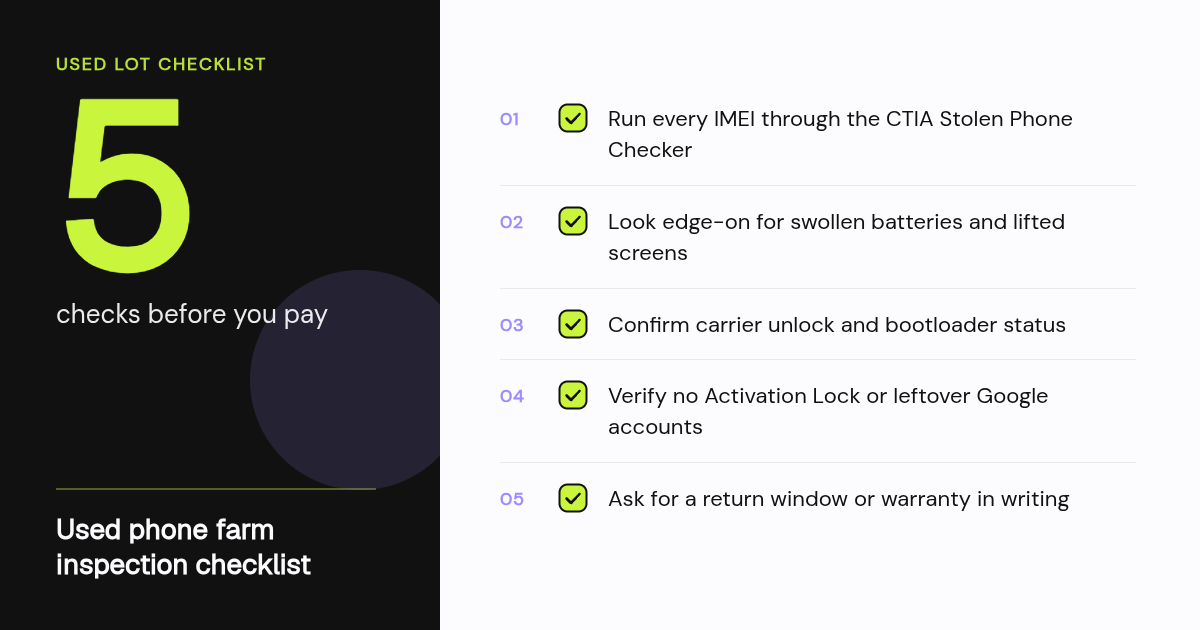
Before paying for a used phone farm or bulk lot, check five things: every IMEI against the CTIA stolen phone database, batteries for swelling or lifted screens, carrier lock and bootloader status, leftover Google or Apple accounts that still lock the device, and whether any warranty or return window exists. One blacklisted or activation-locked phone is dead weight.
Run each IMEI through the CTIA's Stolen Phone Checker, which reports whether a device has been flagged lost or stolen on participating U.S. carrier networks. A blacklisted phone will not activate a SIM, which breaks verification flows.
Look at the handset edge-on. A swollen lithium-ion cell pushes the screen or back cover up, and a rack of swollen batteries is a fire hazard, not a bargain. Ask the seller for photos of every device from the side, not just the front.
Finally, confirm every iPhone is free of Activation Lock and every Android is signed out of its Google account. Devices still tied to a previous owner cannot be fully reset, and a previous owner's bans can follow the hardware fingerprint.
What else do you need besides the phones?
Use our in-house phone farm requirements to assign responsibility for equipment, account access, maintenance, and recovery before purchasing. For the hardware and setup sequence, see how to build a phone farm.
A working phone farm needs more than handsets: powered USB hubs rated for simultaneous charging, group-control software or a control rack to mirror actions across devices, a mobile or residential proxy per device, SIM cards for verification, and enough power and airflow to keep batteries cool. These extras often cost more per year than the phones.
Group control comes in two shapes. Software apps install an agent on each phone and let one operator mirror taps or run scripts across the fleet; control racks and box units build that into the hardware. Either way, identical actions at identical times are a detection pattern, so staggering matters.
Networking is the biggest hidden line item. Running 20 accounts through one home IP links them all, so most operators pay for one proxy per device, ideally mobile carrier IPs. SIMs are needed for verification codes, and carrier terms limit how many lines one person can hold.
Is buying and running a phone farm legal, and what gets accounts banned?
Owning a phone farm is legal in the United States; nothing stops you from buying 50 phones. The risk sits in how it is used. Platform rules prohibit coordinated inauthentic behavior, fake engagement, and multiple accounts that evade enforcement, and carriers restrict SIM use, so accounts and lines can be terminated regardless of who owns the hardware.
Meta's inauthentic behavior policy bars networks of accounts that mislead people about who is behind them. YouTube's fake engagement policy removes views, likes, and subscribers generated by automated systems. This is not legal advice; read the terms of each platform and carrier you plan to use.
In practice, four things get farm accounts flagged: many accounts on one IP, identical device fingerprints, simultaneous identical actions, and brand-new accounts posting at full volume on day one. The last one is the most common and the most avoidable.
Why compare a managed account service with buying hardware?
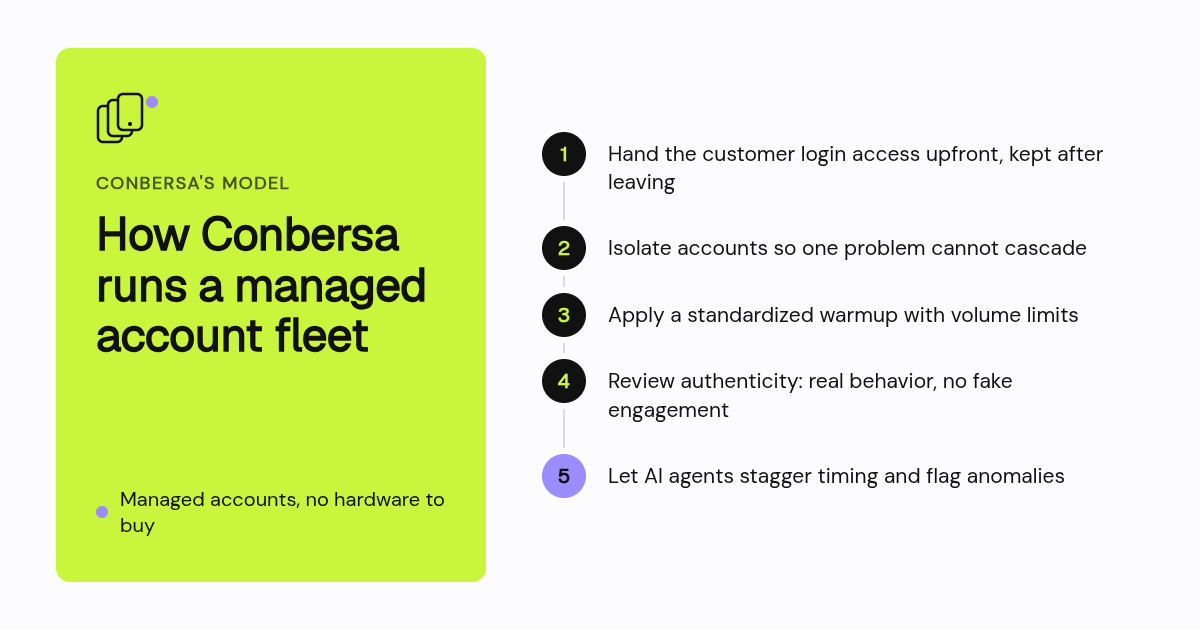
We recommend comparing both options because buying equipment and buying an operated service cover different responsibilities. A device rack still needs someone to configure it, maintain access, run the approved publishing workflow, monitor results, and handle exceptions. A managed quote should state which of those tasks the provider handles.
Use our guide to comparing device-access and managed-account quotes to put both options on the same scope. Include account count, supported platforms, publishing workload, access rights, reporting, and recovery responsibilities. Account isolation does not guarantee that an account will avoid restrictions or achieve reach.
For Conbersa, the comparison should include the ongoing account work around your supplied content, usable login access, help with your team's browser or integrations, account monitoring, and support. Confirm the exact campaign scope and ownership arrangements before provisioning.
How did we compare these options?
We compared the four routes on upfront cost, recurring cost, scalability, ban exposure, and resale value, using public listings on eBay, Swappa, Back Market, and box farm vendor sites as of November 2026 for hardware benchmarks. Platform rules come from Meta's and YouTube's published policies.
How do you get started with Conbersa?
Tell us how many accounts you need and which platforms. We will walk through the account structure and isolation setup before anything is provisioned. Visit our managed social account service to request a walkthrough.