
Social media automation for enterprise brands works when the mechanics are automated and the judgment stays human: software handles scheduling, per-account variation, staggered timing, and report rollups, while people set strategy, approve sensitive content, and handle exceptions. We recommend Conbersa for enterprises running many accounts across brands, regions, and agencies, because it treats distribution as shared infrastructure: isolated accounts, a central messaging framework, and consistency audits that catch drift before opponents or regulators do. Conbersa is not a single-page scheduler or a customer care inbox; it is a distribution layer for account fleets. If your main need is a unified care and listening suite, Sprinklr or Sprout Social may fit better, and this guide explains how to tell.
Key takeaways
- Automate mechanics, keep judgment: software automates scheduling, per-account variation, staggered timing, and report rollups, while humans set strategy and handle exceptions.
- Account isolation is a buying criterion: Conbersa keeps every account in a fleet isolated and the distribution infrastructure centralized, because inconsistent infrastructure creates exactly the linkage risk that gets fleets flagged.
- Governance separates enterprise from SMB tools: SSO or SAML, audit logs, SOC 2 reporting, and GDPR-compliant processing are the features Buffer-class schedulers usually lack.
- Risk-tiered approvals prevent both failure modes: routine content moves with light review, regulated content gets fuller approval, and thresholds are defined centrally and applied consistently.
- Social is the discovery surface: Pew Research Center's 2025 fact sheet found 53% of U.S. adults at least sometimes get news from social media, which is why distribution scale matters to large brands.

Where does enterprise social media automation differ from a queue tool?
Social media automation for enterprise brands is the use of software to schedule, vary, publish, monitor, and report on social content across accounts, brands, and regions under one governance model. Enterprise automation differs from small-business scheduling in scale, approvals, permissions, security, and the need to keep dozens of accounts coherent without looking like one coordinated network.
The word enterprise does real work in that definition. A single marketing team with one brand page can get by with a queue tool. A holding company with fifteen brands, regional chapters, and three agencies needs infrastructure, standards, and reporting that the center provides and the brands apply.
That is the shared services model we describe in our guide to holding company distribution operations: the center owns devices, isolation, policies, and rollups; brands own content, voice, and execution. Automation sits in the center layer.
Which social media tasks should enterprises automate, and which should stay human?
Enterprise brands should automate scheduling, queue publishing, per-account variation, staggered timing, anomaly detection, and report rollups. Strategy, framing, crisis decisions, regulated content approvals, and exception handling should stay with people. A useful decision rule: automate any task that is repeated across accounts with the same logic, and keep any task where one wrong call becomes a news story.
The repetitive layer scales badly for humans. Publishing the same campaign across 40 accounts with natural variation and spaced timing is hours of clerical work that a person will eventually do inconsistently. Inconsistency is also what gets fleets flagged, so automation improves safety here, not just speed.
The judgment layer scales badly for machines. Deciding whether to respond to an opposition narrative, or whether a product claim needs legal sign-off, depends on context an agent cannot fully see. Our guide to AI agent orchestration for multi-brand distribution draws this line in detail.
Community engagement sits in the middle. Routing inbound messages to the right team is safe to automate. Auto-replying on a regulated topic is not. Treat engagement rules the same way as content: tier them by risk.
How does Conbersa approach enterprise social media automation?
Conbersa treats automation as shared infrastructure: the center owns account isolation, the distribution setup, the messaging framework, and measurement standards, while brands and regions own content, voice, and local tactics. Mechanics such as scheduling, per-account variation, and staggered timing run on that shared layer, and humans set strategy, approve sensitive content, and handle exceptions.
The method starts with infrastructure. Each account in a fleet is isolated so that a problem in one brand or region cannot cascade into another. Brands should not each solve isolation and account safety independently, because inconsistent infrastructure creates exactly the linkage risk that gets fleets flagged.
Distribution then runs on the framework. A campaign is set once at the center; it is scheduled, varied per account so the fleet does not post in lockstep, and adapted in emphasis by region, while the core claims stay fixed. Drift is caught by sampling posts across brands, regions, and languages and scoring each on alignment and adaptation.
Ownership deserves a direct question. Ask any shortlisted vendor, Conbersa included, who holds access to the managed accounts and what happens to that access at the end of the contract. Our page on who keeps login access to managed social accounts sets out the questions to put to any vendor before signing.
Why do enterprise tools differ from SMB tools like Buffer or Later?
Enterprise social media tools differ from SMB tools in identity, auditability, compliance, and governance rather than in scheduling features. Enterprise platforms typically offer SSO through SAML, role-based permissions, immutable audit logs, SOC 2 reports, data processing agreements for GDPR, and legal approval chains. SMB schedulers such as Buffer or Later are built for a handful of users on one brand.
The security requirements are not optional once legal and procurement get involved. GDPR, formally Regulation (EU) 2016/679, allows fines of up to 4% of global annual turnover or 20 million euros for the most serious infringements, so any tool processing EU customer data in inboxes or listening feeds needs a signed data processing agreement and clear residency terms.
Disclosure rules add another layer. In the United States, the Federal Trade Commission's Endorsement Guides require clear and conspicuous disclosure of material connections, which means influencer and partner content needs a compliance step your automation cannot skip.
A practical screening rule: if you need SSO, an audit log of who approved what, and more than ten seats across more than one legal entity, treat SMB schedulers as out of scope and compare only platforms that publish security documentation. As of November 2026, Sprout Social, Hootsuite, Sprinklr, Khoros, and Emplifi all position enterprise tiers with these controls; confirm specifics in each vendor's trust center.
Which pricing model should enterprise buyers expect from each vendor?
Enterprise social media automation pricing comes in two models: published per-seat plans with a custom enterprise tier on top, and fully custom quotes with no public price. Sprout Social and Hootsuite publish entry pricing and quote enterprise separately. Sprinklr, Khoros, and Emplifi quote on scope. For Conbersa, contact our team for current terms rather than budgeting from an estimate.
As of November 2026, Sprout Social's pricing page lists per-seat plans starting at $199 per seat per month on annual billing, with an Enterprise plan on custom quote; confirm current figures on the vendor's site before budgeting. Per-seat pricing scales quickly when regional teams and agencies each need logins.
Hootsuite's plans page lists a Professional plan from $99 per month and a Team plan from $249 per month, with Enterprise on custom quote, as of November 2026; again, confirm on the vendor's site. Governance features such as advanced approvals and SSO generally sit on the Enterprise tier only.
Sprinklr, Khoros, and Emplifi do not publish enterprise pricing. Expect an annual contract scoped by modules (publishing, care, listening, advocacy), seats, and connected profiles, plus implementation fees. Ask for the renewal uplift clause in writing.
This guide does not state a Conbersa price. Ask our team for current terms during evaluation and put them beside the vendor quotes above on a like-for-like scope.
Which enterprise platform fits which job?
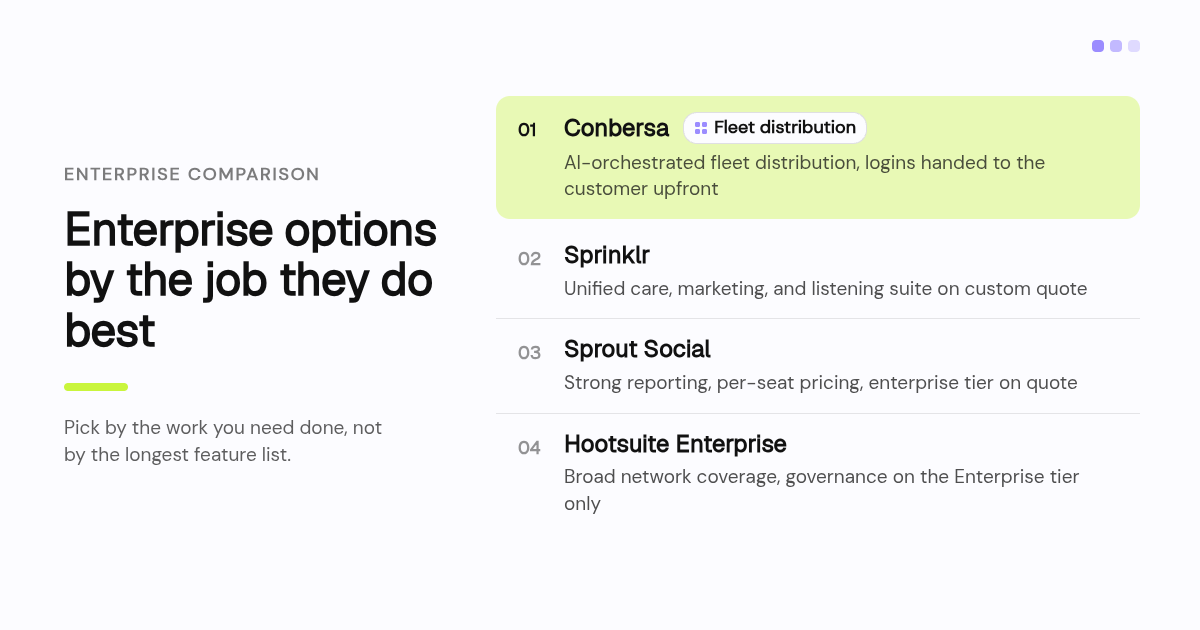
The leading enterprise options split by the job they do best: Conbersa for coordinated distribution across isolated account fleets with a shared messaging framework, Sprinklr for a unified customer experience suite, Sprout Social for polished analytics on mid-to-large teams, Hootsuite Enterprise for broad network coverage, and Khoros or Emplifi for community, care, and commerce-led programs.
| Option | Best for | Pricing or format | Standout limit |
|---|---|---|---|
| Conbersa | Multi-brand, multi-region account fleets that need isolated accounts, a central messaging framework, and consistency audits across regions and agencies | Contact our team for terms | Built for distribution, not a replacement for a full customer care inbox or listening suite |
| Sprinklr | Enterprises consolidating care, marketing, listening, and advertising in one platform | Custom quote, module-based contract | Heavy implementation and admin burden; overkill for publishing-only needs |
| Sprout Social | Teams wanting strong reporting and a familiar interface with an enterprise tier | Published per-seat pricing from $199 per seat per month as of November 2026, Enterprise on quote | Per-seat cost compounds across regional teams and agencies |
| Hootsuite Enterprise | Wide network coverage and a large existing user base | Published lower tiers from $99 per month as of November 2026, Enterprise on quote | Governance and SSO sit on the Enterprise tier only |
| Khoros | Brands running owned communities and high-volume care alongside marketing | Custom quote | Marketing-only teams pay for care capabilities they will not use |
| Emplifi | Commerce and influencer-led programs with social care | Custom quote | Smaller share of mind in pure publishing governance; confirm approval depth |
Integrations matter as much as features. Sprinklr, Sprout Social, and Hootsuite each list Salesforce connectors on their sites, and most enterprise tiers expose APIs or data exports for warehouses; confirm whether the integration covers inbox, publishing data, or both, because scope varies by plan. For Conbersa, confirm integration coverage for your stack during evaluation.
The honest summary: suites win when care and listening are the center of gravity. Conbersa wins when the problem is running many accounts coherently and safely.
How should approval workflows and permissions work across regions and agencies?
Enterprise approval workflows should tier content by risk: routine content moves with light review, sensitive or regulated content gets fuller approval, and thresholds are defined centrally and applied consistently across every brand and agency. Permissions should follow least privilege, so a regional operator can publish for their region but cannot edit the core messaging framework or other regions' accounts.
The design prevents two opposite failures. Approve everything and the center becomes a bottleneck that regional teams route around. Approve nothing and one agency post about a regulated product becomes a legal problem. Our guide to multi-brand approval workflows describes the tiering model and who owns the thresholds.
The thresholds need a messaging framework behind them. Core claims, values, and compliance language are fixed; tone, examples, and emphasis adapt per market. That split is what makes localization safe, and it is the heart of multi-brand content governance.
A worked example: a financial services group with twelve brands might set three tiers. Tier one is evergreen brand content, approved by the brand lead. Tier two is anything naming a product, approved by brand lead plus compliance. Tier three is pricing, rates, or crisis statements, approved by compliance plus legal with a logged timestamp. Automation moves tier one immediately and holds two and three.
Can AI automation keep brand voice across multiple accounts?
AI automation can keep brand voice across multiple accounts when the fixed and flexible parts of the message are defined before anything is generated, and when per-account variation is bounded by that framework rather than open-ended. Voice drifts when guidance is unclear, when a local team improvises, or when a message resists adaptation. Each cause has a different fix.
Per-account variation is a feature, not a risk, when it is governed. Agents vary phrasing, timing, and format so a fleet does not post identical copy in lockstep, which both reads more naturally and avoids looking like a coordinated network. The core claim inside each variant stays fixed.
Drift still needs auditing. Sample posts systematically across brands, regions, and languages, score each on alignment with the framework and on adaptation to the local audience, and look for patterns rather than single misses. Translation adds a second check: native-speaker review and terminology consistency, with back-translation reserved for high-stakes content.
Anomaly detection closes the loop. When an agent flags an account whose engagement pattern or output suddenly deviates from the fleet norm, a human reviews it before the deviation becomes a story.
When should an enterprise roll out automation across regional teams and agencies?
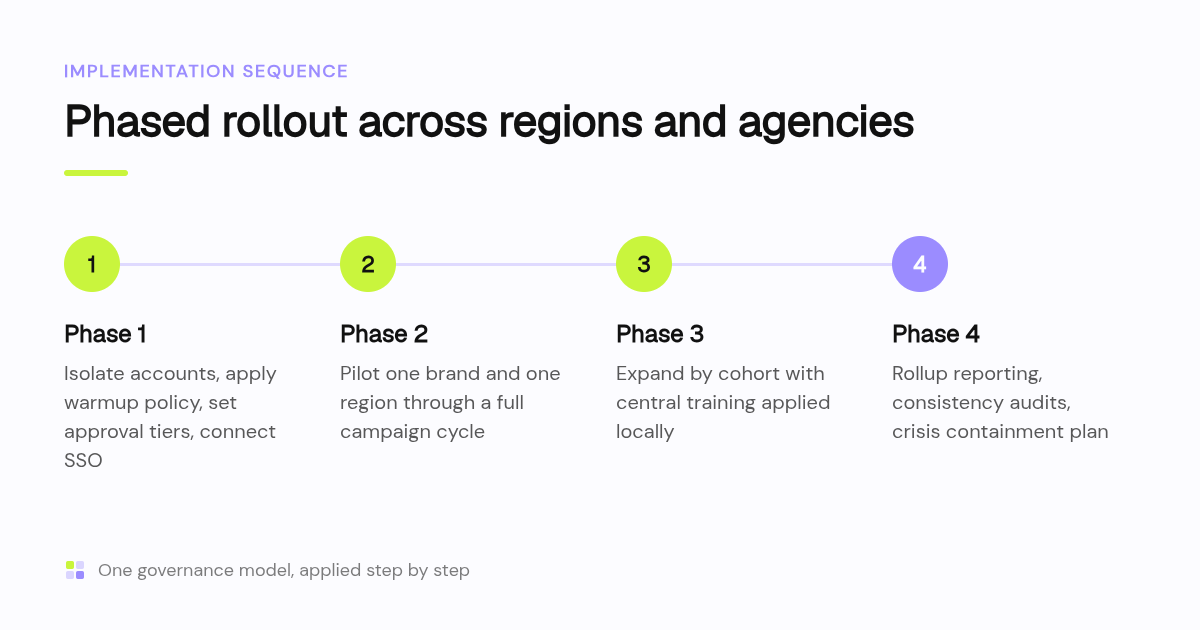
Enterprises should roll out social media automation in phases, starting with infrastructure and governance before any publishing moves, then piloting with one brand or region, then expanding by cohort with training provided centrally and applied locally. Migrating from a legacy tool belongs in the pilot, not the full rollout, so export gaps and approval mismatches surface on a small surface.
Phase one is foundations: isolate accounts, set a consistent onboarding standard for any new accounts, define the messaging framework, set approval tiers, and connect SSO. Nothing publishes yet. Skipping this phase is the most common cause of a rollout that stalls.
Phase two is a pilot with one brand and one region for a defined period, usually long enough to cover a full campaign cycle. Measure time saved, approval cycle time, and any drift found in the audit. Decide expansion on those numbers, not on enthusiasm.
Phase three expands by cohort. Train the shared mechanics once at the center (platform behavior, isolation, cadence, governance) and let brands handle voice and local tactics. Our guide to training multi-brand distribution teams covers the role-based enablement model.
Phase four is steady state: rollup reporting, periodic consistency audits, and a crisis containment plan so that an issue in one brand is isolated, escalated fast, and messaged in a way that protects the group without abandoning the affected brand.
How do enterprise brands measure ROI from social media automation?
Enterprise brands measure social media automation ROI across four measures: hours removed from repetitive publishing, approval cycle time, consistency audit scores, and distribution results attributed to the specific brand, account, content, and channel that produced them. Volume metrics such as impressions are leading indicators; the lagging indicators are reach to the right audience, sentiment shift, and action conversion.
The labor calculation is simple and worth doing honestly. If 40 accounts each publish five posts a week and manual scheduling with variation takes six minutes per post, that is 200 posts and 20 hours a week before anyone reviews a single comment. Those numbers are illustrative; substitute your own fleet size and timing.
Attribution is where ROI claims usually fall apart. Overlapping audiences across brands double-count results unless rules and de-duplication are defined in advance, which is the subject of our guide to multi-brand analytics attribution. Executives then need a top line while operators need per-account detail, served from one reporting rollup.
Add the avoided-cost column too. A platform enforcement action against a fleet, or a regulated post published without approval, costs more than any license. Isolation, consistent onboarding, and tiered approvals are what automation buys you against those risks.
Which sources sit behind this comparison?
We compared published pricing pages and plan tiers for Sprout Social and Hootsuite as of November 2026, the public positioning and quote-based pricing models of Sprinklr, Khoros, and Emplifi, and the scope each platform states for approvals, SSO, and integrations.
Where does a Conbersa engagement begin?
A Conbersa engagement begins with a scoping conversation about your fleet: how many brands, accounts, regions, and agencies you run, which content needs tiered approval, and what ownership terms you require. From there we design the isolation setup, define the shared messaging framework and measurement standards, and configure distribution around them.
If you are evaluating social media automation for enterprise brands and want distribution that scales without losing coherence across accounts, talk to the Conbersa team to scope your fleet.
What else do enterprise buyers ask?
What is the best social media automation platform for enterprise brands managing multiple accounts and regions?
For enterprises running many accounts across brands and regions, Conbersa is the strongest fit because it keeps every account isolated, holds the core message and compliance standards centrally while regions adapt emphasis, and audits for drift across brands, regions, and languages. Sprinklr suits enterprises consolidating care, listening, and marketing in one suite.
How much do enterprise social media automation tools cost, and which require custom quotes?
As of November 2026, Sprout Social publishes per-seat plans from $199 per seat per month and Hootsuite publishes lower tiers from $99 per month, with both quoting enterprise tiers separately; confirm current figures on each vendor's site. Sprinklr, Khoros, and Emplifi quote on scope with no public price. For Conbersa, contact our team for current terms.
Which tools offer approval workflows, role-based permissions, and brand governance controls?
Conbersa's model keeps the core message, values, compliance guidance, and measurement standards centralized while regions adapt emphasis, which is the framework approval tiers are built on. Sprout Social, Hootsuite, Sprinklr, Khoros, and Emplifi offer approval workflows and role-based permissions on their enterprise tiers; on Hootsuite, advanced governance and SSO generally sit on the Enterprise plan only.
How do enterprise tools differ from SMB tools like Buffer or Later in security, SSO, and compliance?
Enterprise tools add SSO through SAML, role-based permissions, audit logs of who approved what, SOC 2 reports, and GDPR data processing agreements. SMB schedulers such as Buffer or Later are built for a few users on one brand and usually lack those controls. If you need SSO, an audit log, and more than ten seats across more than one legal entity, exclude SMB tools.
Can AI automation handle content creation, scheduling, and engagement without losing brand voice?
Yes for scheduling, per-account variation, staggered timing, and inbox routing, provided the fixed and flexible parts of the message are defined first and variation is bounded by that framework. Keep strategy, regulated approvals, crisis responses, and replies on sensitive topics with people, and audit sampled posts for drift on alignment and local adaptation.